
Apr . 01, 2024 17:55 Back to list
two wire braided hydraulic hose Performance Analysis
Introduction
Two wire braided hydraulic hose is a flexible reinforced conduit designed to transmit hydraulic fluid under pressure. Positioned within the broader fluid power industry, it serves as a critical component in systems ranging from construction equipment and agricultural machinery to industrial manufacturing and aerospace applications. Unlike rubber hoses without reinforcement, or those with single-wire braiding, the dual-layer braid significantly enhances pressure capabilities and resistance to kinking and abrasion. Core performance characteristics revolve around burst pressure, working pressure, temperature resistance, and fluid compatibility. Industry pain points include ensuring consistent manufacturing quality, maintaining dimensional stability under fluctuating temperatures and pressures, and mitigating risks associated with premature failure due to improper installation or fluid contamination. Achieving extended service life and maximizing uptime are paramount concerns for end-users.
Material Science & Manufacturing
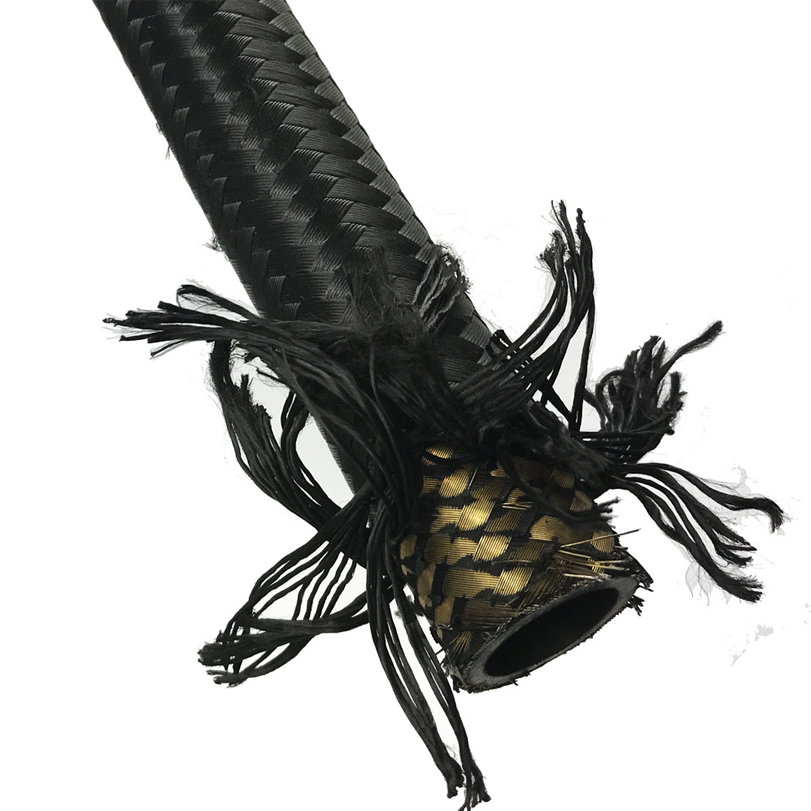
The construction of two wire braided hydraulic hose involves several key material considerations. The inner tube is typically composed of synthetic rubbers, commonly nitrile (NBR) for oil-based hydraulic fluids, or fluorocarbon (FKM/Viton) for aggressive chemical environments or high-temperature applications. NBR offers excellent abrasion resistance and compatibility with petroleum-based fluids, while FKM provides superior heat and chemical resistance, though at a higher cost. The reinforcement layer consists of high-strength steel wire, typically drawn to precise diameters and surface finishes to maximize fatigue life and minimize corrosion susceptibility. The wire’s tensile strength is a crucial parameter. An outer cover, usually a synthetic rubber such as chloroprene (CR) or polyurethane (PU), provides protection against abrasion, ozone, weathering, and oil contamination. CR is a cost-effective general-purpose cover, while PU offers enhanced abrasion and chemical resistance.
Manufacturing commences with extrusion of the inner tube to the specified dimensions and wall thickness. Subsequent braiding involves precisely winding two layers of steel wire helically around a mandrel. Braiding angle and wire tension are rigorously controlled to achieve the desired hose flexibility and burst pressure. The braided structure is then vulcanized (cured) to bond the reinforcement to the inner tube and activate the rubber compounds. Finally, the outer cover is extruded over the braided layer, followed by a final curing process. Key parameter control during manufacturing includes rubber compound viscosity, wire tension and angle during braiding, vulcanization temperature and time, and dimensional inspection to ensure adherence to industry standards. Non-destructive testing methods, such as eddy current testing, are employed to detect wire breaks or irregularities in the braided layers. Fluid cleanliness during the assembly process is vital to prevent internal contamination and premature failure.
Performance & Engineering
The performance of two wire braided hydraulic hose is dictated by a complex interplay of mechanical stresses and environmental factors. Force analysis considers internal pressure, external bending forces, and axial tension. Burst pressure, defined as the pressure at which the hose fails catastrophically, is a primary design criterion. Working pressure is typically specified as a fraction of the burst pressure, commonly 50% or 75%, to provide a safety margin. Bending radius is critical; exceeding the minimum bend radius induces excessive stress on the reinforcement layers, leading to fatigue failure. Impulse pressures (pressure spikes) also contribute to fatigue and necessitate careful hose selection for dynamic applications. Environmental resistance encompasses temperature range, fluid compatibility, and exposure to UV radiation, ozone, and corrosive substances. The hose must maintain its flexibility and structural integrity across the specified temperature range. Fluid compatibility ensures that the rubber compounds do not swell, degrade, or leach contaminants into the hydraulic fluid. Compliance requirements, such as those stipulated by SAE J517 and EN 856, govern hose testing procedures, performance specifications, and marking requirements.
Finite Element Analysis (FEA) is often employed during the design phase to simulate stress distributions under various loading conditions and optimize hose geometry and reinforcement configuration. Material selection is guided by considerations of tensile strength, elongation at break, modulus of elasticity, and fatigue resistance. Proper end fitting crimping is paramount; insufficient crimp force leads to leakage, while excessive crimp force damages the hose reinforcement. Detailed installation procedures and torque specifications must be followed to ensure reliable performance and prevent premature failure. Hose guards are frequently utilized to protect against abrasion, impact, and environmental exposure in demanding applications.
Technical Specifications
| Parameter | Unit | Specification (Typical) | Test Standard |
|---|---|---|---|
| Working Pressure | MPa | 20 | SAE J517 |
| Burst Pressure | MPa | 80 | SAE J517 |
| Temperature Range | °C | -40 to +100 | SAE J517 |
| Inner Tube Material | - | NBR (Nitrile Rubber) | ASTM D2000 |
| Reinforcement | - | Two Steel Wire Braids | SAE J517 |
| Outer Cover Material | - | CR (Chloroprene Rubber) | ASTM D2000 |
Failure Mode & Maintenance
Common failure modes in two wire braided hydraulic hose include burst failure due to exceeding pressure limits, fatigue cracking resulting from repeated bending or impulse pressures, pinhole leaks caused by abrasion or corrosion, and fitting failure due to improper crimping or contamination. Fatigue cracking typically initiates at areas of high stress concentration, such as near the end fittings or at points of sharp bending. Delamination can occur between the rubber layers and the wire reinforcement, reducing the hose’s burst pressure capability. Oxidation of the steel wire, particularly in corrosive environments, leads to a reduction in tensile strength and increased susceptibility to fatigue. Internal degradation of the rubber compounds can occur due to chemical attack from incompatible fluids or contamination.
Preventative maintenance involves regular visual inspection for signs of damage, such as cracks, abrasions, bulges, or leaks. Hose routing should be designed to minimize bending stress and protect against abrasion. Fluid cleanliness is paramount; using appropriate filters and maintaining proper fluid levels minimizes contamination. End fittings should be inspected for corrosion or damage. Hose replacement should be performed at scheduled intervals or whenever signs of degradation are observed. When replacing a hose, it’s critical to use fittings that are compatible with the hose and rated for the intended operating pressure. Crimping procedures must be meticulously followed to ensure a secure and leak-proof connection. Proper storage of hoses, protected from UV radiation and extreme temperatures, extends their service life.
Industry FAQ
Q: What is the impact of exceeding the minimum bend radius on hose life?
A: Exceeding the minimum bend radius significantly reduces hose life by inducing excessive stress on the wire reinforcement. This leads to premature fatigue cracking and eventual failure. The tighter the bend, the greater the stress concentration and the faster the hose will degrade. Proper hose routing and support are crucial to maintain the specified bend radius.
Q: How does fluid contamination affect hose performance?
A: Fluid contamination can lead to several failure mechanisms. Abrasive particles can erode the inner tube, causing leaks. Chemical contaminants can degrade the rubber compounds, reducing their elasticity and strength. Water contamination can promote corrosion of the wire reinforcement. Maintaining fluid cleanliness through filtration is essential for maximizing hose service life.
Q: What is the difference between NBR and FKM inner tubes, and when should each be used?
A: NBR (Nitrile Rubber) is a cost-effective option for general-purpose hydraulic fluids, offering good abrasion resistance and compatibility with petroleum-based oils. FKM (Viton) provides superior resistance to high temperatures, aggressive chemicals, and fuels. FKM is recommended for applications involving phosphate ester fluids, high-temperature environments, or exposure to harsh chemicals.
Q: What are the implications of using incorrect crimp specifications for end fittings?
A: Incorrect crimp specifications can lead to significant problems. Insufficient crimp force results in leakage, while excessive crimp force damages the wire reinforcement, reducing the hose’s burst pressure and increasing the risk of fatigue failure. Using the correct crimp tool and die set, and adhering to the manufacturer's specifications, is critical.
Q: How can I determine the appropriate working pressure for a specific application?
A: The working pressure should be selected based on the maximum system pressure, anticipated pressure spikes, and the hose’s burst pressure. A safety factor of 4:1 is commonly used, meaning the working pressure should not exceed 25% of the burst pressure. Consider the operating temperature and fluid compatibility when selecting the hose.
Conclusion
Two wire braided hydraulic hose represents a vital component within numerous industrial sectors, delivering a robust and reliable solution for fluid power transmission. Its performance is intrinsically linked to material selection, meticulous manufacturing processes, and adherence to stringent industry standards. Understanding the potential failure modes, implementing preventative maintenance procedures, and prioritizing proper installation practices are critical for maximizing service life and minimizing downtime. The dual-wire braid construction provides a significant enhancement in pressure and durability compared to single-braid alternatives.
Future advancements in hydraulic hose technology will likely focus on developing lighter-weight materials, improving abrasion and chemical resistance, and incorporating smart sensing capabilities for real-time monitoring of hose condition. Continued emphasis on quality control, standardized testing procedures, and rigorous adherence to safety regulations will be essential for ensuring the long-term reliability and performance of these critical components.