
Apr . 01, 2024 17:55 Back to list
profession manufacturer hydraulic hose factory Performance Analysis
Introduction
Hydraulic hose, a critical component in fluid power systems, serves as a flexible conduit for transmitting hydraulic fluid to actuators and other components. Profession manufacturer hydraulic hose factories are integral to industries ranging from construction and agriculture to manufacturing and aerospace. This guide provides a comprehensive technical overview of hydraulic hose, encompassing material science, manufacturing processes, performance characteristics, failure modes, and industry standards. The core performance attributes of hydraulic hose – pressure capacity, temperature resistance, flexibility, and resistance to fluid degradation – dictate its suitability for specific applications and operating environments. A key industry pain point is maintaining consistent quality and traceability, particularly with the increasing complexity of hose constructions and the demand for high-performance applications requiring extended service life. Selecting the correct hose for the application, coupled with proper installation and maintenance, is paramount to ensuring system reliability and preventing catastrophic failure.
Material Science & Manufacturing
Hydraulic hose construction typically involves four key layers: the inner tube, reinforcement layers, and the outer cover. The inner tube, which comes into direct contact with the hydraulic fluid, is commonly manufactured from synthetic rubbers such as Nitrile (NBR), Ethylene Propylene Diene Monomer (EPDM), or Fluorocarbon (FKM/Viton). NBR offers excellent resistance to petroleum-based fluids, EPDM excels in phosphate ester fluids, and FKM provides superior resistance to high temperatures and aggressive chemicals. Reinforcement layers provide the hose's pressure-bearing capacity and are typically composed of multiple plies of high-tensile steel wire, textile braids (typically polyester or aramid), or a spiral wound steel wire. The outer cover, providing environmental protection and abrasion resistance, is generally made from synthetic rubbers like Chloroprene (CR) or Polyurethane (PU).
Manufacturing processes vary depending on hose type. Braided hose construction involves spiraling steel wire or textile around a mandrel, followed by vulcanization of the rubber layers. Spiral hose manufacturing uses a continuous winding of high-tensile steel wire over the inner tube, followed by external cover application and vulcanization. Parameter control during vulcanization – temperature, pressure, and time – is critical to achieving optimal rubber crosslinking and ensuring consistent mechanical properties. Extrusion is employed for both the inner tube and outer cover, requiring precise control of polymer melt temperature, screw speed, and die design to maintain dimensional accuracy and surface finish. Proper curing of rubber compounds is essential to develop the required tensile strength, elongation, and resistance to degradation. The selection of appropriate rubber compounds considering fluid compatibility is a primary factor in preventing hose failure.
Performance & Engineering
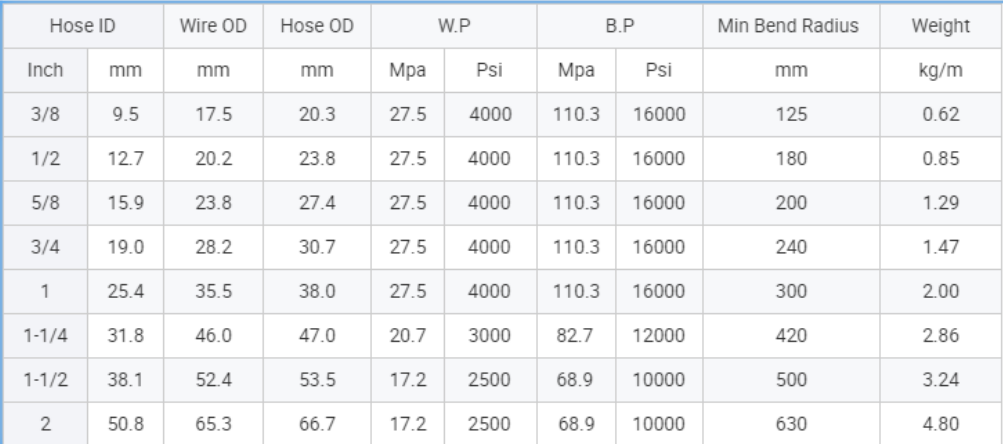
Hydraulic hose performance is governed by several key engineering considerations. Burst pressure, working pressure, and safety factor are paramount. Working pressure represents the maximum continuous operating pressure, while burst pressure indicates the pressure at which the hose fails catastrophically. A safety factor, typically 4:1, is applied to ensure reliable operation under fluctuating load conditions. Hose flexibility, measured by bend radius, is crucial for proper installation and minimizing stress concentrations. Temperature resistance, encompassing both high and low-temperature limits, must be considered based on the operating environment and fluid characteristics. Permeation, the diffusion of hydraulic fluid through the hose wall, is a concern in applications requiring minimal fluid loss and environmental protection.
Force analysis involves calculating the hoop stress within the hose wall due to internal pressure. The reinforcement layers bear the primary load, and their material properties and configuration determine the hose's pressure capacity. Environmental resistance encompasses factors like ozone degradation, UV exposure, and chemical attack. Compliance requirements, such as those stipulated by SAE (Society of Automotive Engineers) and EN (European Norms) standards, dictate minimum performance criteria for hydraulic hose. Functional implementation requires consideration of hose end connections, which can be crimped, swaged, or field-attachable. Proper end fitting selection and attachment are critical to preventing leakage and ensuring a secure connection.
Technical Specifications
| Parameter | Unit | SAE 100R2 AT | SAE 100R6 | EN 856 4SH |
|---|---|---|---|---|
| Working Pressure | MPa | 20.7 | 34.5 | 21 |
| Burst Pressure | MPa | 82.7 | 138 | 84 |
| Temperature Range | °C | -40 to +100 | -40 to +100 | -40 to +100 |
| Inner Tube | Material | NBR | NBR | NBR |
| Reinforcement | Material | 2AT Wire Braid | 4SP Wire Spiral | 4SH Steel Wire Spiral |
| Outer Cover | Material | CR | CR | CR |
Failure Mode & Maintenance
Hydraulic hose failure can manifest in several ways. Fatigue cracking, initiated by repeated bending and flexing, is a common failure mode, particularly in applications involving high dynamic loads. Delamination, the separation of reinforcement layers from the rubber matrix, can occur due to poor bonding or exposure to aggressive fluids. Degradation of the rubber compounds, caused by exposure to ozone, UV radiation, or extreme temperatures, leads to loss of flexibility and eventual cracking. Oxidation of the hydraulic fluid can generate corrosive byproducts that attack the inner tube. Pinholes, caused by abrasion or localized damage, result in fluid leakage.
Maintenance practices are crucial for extending hose service life. Regular visual inspections should be conducted to identify signs of wear, cracking, or swelling. Hose connections should be checked for tightness and corrosion. The hydraulic fluid should be analyzed periodically to monitor its condition and identify any contaminants. Avoid sharp bends and excessive twisting during installation. Protect hoses from abrasion and exposure to extreme temperatures. Replace hoses proactively based on recommended service intervals or if any signs of damage are observed. Proper hose routing and support are essential to prevent stress concentrations and premature failure. Always depressurize the hydraulic system before disconnecting or replacing hoses.
Industry FAQ
Q: What is the impact of fluid incompatibility on hydraulic hose life?
A: Fluid incompatibility can severely reduce hose life. Incorrect fluid can cause swelling, softening, or hardening of the inner tube, leading to permeation, cracking, and eventual failure. Always verify that the hose material is compatible with the hydraulic fluid being used, referencing compatibility charts provided by hose manufacturers.
Q: How does steel wire reinforcement affect hose performance compared to textile reinforcement?
A: Steel wire reinforcement provides significantly higher pressure capacity and resistance to elongation compared to textile reinforcement. However, steel wire hose is generally less flexible. Textile reinforced hose offers greater flexibility but has lower pressure ratings. The choice depends on the specific application requirements.
Q: What are the key considerations when selecting hose end fittings?
A: Hose end fittings must be compatible with the hose type, fluid type, and operating pressure. Proper crimping or swaging is critical to ensure a leak-free connection. Fittings should be made from corrosion-resistant materials. Consider the type of connection required (e.g., threaded, flanged, quick-disconnect).
Q: How can I identify the correct hose for a specific application?
A: Consider the operating pressure, temperature range, fluid compatibility, bend radius, and environmental conditions. Consult hose manufacturer catalogs and technical specifications. Engage with a hydraulic hose specialist to ensure proper selection.
Q: What is the role of hose guarding in preventing failures?
A: Hose guarding provides physical protection against abrasion, impact, and environmental exposure. It prevents hose rupture due to external damage and minimizes the risk of fluid spray in the event of a pinhole leak. Hose guarding is particularly important in applications where hoses are exposed to hazardous environments.
Conclusion
Hydraulic hose is a vital component demanding careful consideration of material science, manufacturing processes, and operational parameters. Selecting the appropriate hose, considering fluid compatibility, pressure ratings, temperature requirements, and environmental conditions, is paramount to ensuring system reliability and preventing premature failure. Adhering to established industry standards and implementing proactive maintenance practices will maximize hose service life and minimize the risk of costly downtime.
The ongoing development of advanced hose materials and manufacturing techniques continues to enhance performance and durability. Future trends include the adoption of composite reinforcement materials, improved permeation resistance, and the integration of smart sensing technologies for real-time condition monitoring. Profession manufacturer hydraulic hose factories play a crucial role in driving these innovations and providing customers with high-quality, reliable fluid power solutions.