
Apr . 01, 2024 17:55 Back to list
one wire braided hydraulic hose suppliers Performance Analysis

Introduction
One wire braided hydraulic hose constitutes a critical component in fluid power systems, serving as a flexible conduit for the transmission of hydraulic fluid under significant pressure. Its position within the industrial chain lies between the hydraulic pump/valve and the actuating cylinder or motor. This hose type differentiates itself from two-wire and four-wire braided alternatives through its balanced cost-effectiveness and pressure-handling capability. Core performance characteristics encompass pressure rating, burst pressure, flexibility, temperature resistance, and compatibility with various hydraulic fluids. A key industry pain point centers on ensuring long-term reliability and preventing catastrophic failure, stemming from issues like hose degradation, connection failures, and inadequate pressure capacity for application demands. The selection of appropriate hose construction, fitting compatibility, and operational parameters is paramount to mitigating these risks.
Material Science & Manufacturing
The construction of one wire braided hydraulic hose relies on several key materials. The inner tube is typically composed of synthetic rubber compounds, specifically nitrile rubber (NBR) for oil-based hydraulic fluids, or fluorocarbon rubber (FKM, Viton) for high-temperature and aggressive fluid applications. These elastomers exhibit excellent resistance to swelling, cracking, and degradation when exposed to hydraulic fluids. The reinforcement layer consists of a single helical braid of high-strength steel wire, providing tensile strength and pressure resistance. Steel wire is often high-carbon steel, heat-treated for enhanced strength and ductility. The outer cover, again usually a synthetic rubber, provides protection against abrasion, weathering, and oil contamination; commonly used materials include Chloroprene rubber (CR) and Polyurethane (PUR).
Manufacturing involves a multi-step process. Firstly, the inner tube is extruded through a die to achieve the desired diameter and wall thickness. Secondly, the steel wire braid is applied helically over the inner tube using a braiding machine, ensuring consistent pitch and coverage. Thirdly, the outer cover is extruded over the braided layer, encapsulating the reinforcement and providing the final protective layer. Critical parameters in this process include extrusion temperature, braid tension, and curing time. Precise control of these parameters ensures consistent hose dimensions, mechanical properties, and fluid compatibility. Post-extrusion, hoses undergo rigorous testing, including pressure testing, impulse testing, and dimensional inspection, to verify compliance with industry standards.
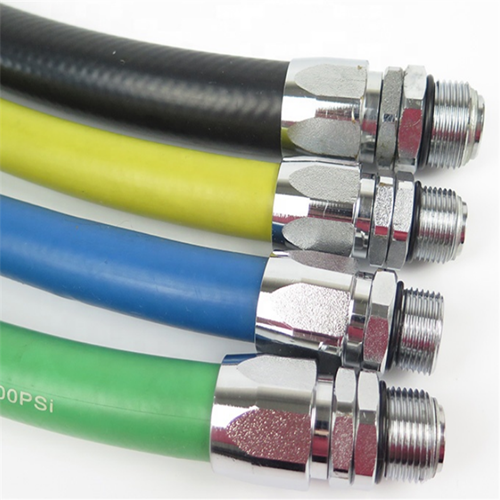
Performance & Engineering
The performance of one wire braided hose is governed by principles of fluid mechanics and material stress analysis. Hose pressure rating is determined by the tensile strength of the steel wire braid and the burst strength of the inner tube and outer cover. The allowable working pressure is significantly lower than the burst pressure, incorporating a safety factor dictated by industry standards (e.g., 4:1). Flexibility is a function of hose diameter, wall thickness, and braid angle; smaller diameter hoses with tighter braid angles exhibit greater flexibility. Environmental resistance is a critical consideration, particularly in applications involving exposure to extreme temperatures, UV radiation, ozone, and corrosive substances. Material selection – specifically the rubber compounds – dictates performance under these conditions.
Engineering design involves careful consideration of hydraulic system parameters, including peak pressure, pressure fluctuations (pulse pressure), fluid temperature, and fluid compatibility. Hose assembly integrity is crucial. Proper crimping of fittings onto the hose is paramount to prevent leakage and ensure a secure connection. Crimping parameters (e.g., crimp size, crimp angle) must be precisely controlled based on the hose and fitting specifications. Fatigue analysis is performed to predict hose life under cyclical loading conditions. This analysis considers stress concentration at the connection points and the material's fatigue strength. Compliance with standards like SAE J517 and EN 856 is mandatory to ensure product safety and performance.
Technical Specifications
| Parameter | Typical Value (SAE 100R1AT Equivalent) | Unit | Test Standard |
|---|---|---|---|
| Working Pressure | 1500 | psi | SAE J517 |
| Burst Pressure | 4500 | psi | SAE J517 |
| Temperature Range | -40 to +100 | °C | SAE J517 |
| Inner Tube Material | Nitrile Rubber (NBR) | - | ASTM D2000 |
| Reinforcement | Single Steel Wire Braid | - | ASTM A228 |
| Outer Cover Material | Chloroprene Rubber (CR) | - | ASTM D2000 |
Failure Mode & Maintenance
One wire braided hydraulic hose is susceptible to several failure modes. The most common include: Hose Burst: Caused by exceeding the working pressure or experiencing a sudden pressure surge. Hose Kinking: Results from excessive bending, restricting fluid flow and potentially damaging the reinforcement. Fitting Failure: Can occur due to improper crimping, corrosion, or material fatigue. Cover Abrasion: Degradation of the outer cover, exposing the reinforcement to corrosion and damage. Internal Degradation: Chemical breakdown of the inner tube due to fluid incompatibility or aging, leading to reduced flexibility and eventual failure. Wire Fatigue: Repeated flexing and pressure cycling can lead to fatigue cracking in the steel wire braid.
Preventative maintenance is critical for extending hose life and preventing catastrophic failures. Regular visual inspections should be conducted to identify signs of abrasion, cracking, bulging, or leakage. Hose assemblies should be replaced if any signs of damage are detected. Fluid compatibility should be verified to ensure the hose material is suitable for the application. Proper hose routing and support are essential to prevent kinking and abrasion. Fittings should be inspected for corrosion and proper crimping. Hose assemblies should be replaced on a scheduled basis, even if no visible damage is apparent, particularly in critical applications. Following manufacturer’s recommendations for hose handling, storage, and installation is crucial. Implementing a robust hose management program can significantly reduce downtime and improve safety.
Industry FAQ
Q: What is the difference between one wire, two wire, and four wire braided hose, and when would I choose one over the others?
A: The number of wire braids directly correlates with the hose’s pressure rating and flexibility. One wire braid offers a balance of cost and performance, suitable for moderate pressure applications (up to approximately 1500 psi). Two wire braid provides increased pressure capability (up to approximately 2250 psi) with reduced flexibility. Four wire braid delivers the highest pressure rating (up to approximately 3000 psi or higher) but with the least flexibility. Selection depends on the specific system pressure requirements and routing constraints. For tight bends, one or two wire braid is preferable. For very high-pressure systems, four wire braid is necessary.
Q: How does temperature affect the performance of a hydraulic hose?
A: Temperature significantly impacts hose performance. Elevated temperatures can accelerate the degradation of rubber compounds, reducing their flexibility and strength. Low temperatures can cause the rubber to become brittle and prone to cracking. Exceeding the specified temperature range can lead to premature failure. The choice of rubber compound (NBR, FKM, etc.) is critical for matching the hose to the application temperature.
Q: What are the key considerations when selecting fittings for a hydraulic hose?
A: Fitting compatibility is paramount. Fittings must be correctly sized and rated for the hose and the system pressure. The fitting material must be compatible with the hose and the hydraulic fluid. Proper crimping is essential to ensure a secure connection. The fitting type (e.g., straight, 90-degree, swivel) must be appropriate for the application. Using non-compatible fittings or improper crimping procedures can lead to leakage and potential failure.
Q: How important is proper hose routing and support?
A: Proper hose routing and support are crucial for preventing damage and ensuring long hose life. Hoses should be routed away from hot surfaces, sharp edges, and moving parts. Support brackets or clamps should be used to prevent sagging, kinking, and abrasion. Avoid excessive bending radii; a larger bend radius reduces stress on the hose. Adequate support minimizes vibration and fatigue, extending hose service life.
Q: What are the implications of using incompatible hydraulic fluids with a specific hose construction?
A: Using an incompatible hydraulic fluid can lead to rapid hose degradation. The fluid can cause swelling, softening, or cracking of the inner tube, compromising its integrity. This can result in leakage, reduced pressure capacity, and eventual hose failure. It’s crucial to verify fluid compatibility with the hose material (e.g., NBR is typically suitable for petroleum-based fluids, while FKM is required for phosphate ester fluids).
Conclusion
One wire braided hydraulic hose remains a widely utilized component in a diverse range of industrial applications due to its favorable balance of cost, performance, and flexibility. Its material composition – specifically the synergistic interplay between the inner tube’s fluid resistance, the steel wire braid’s tensile strength, and the outer cover’s protective capabilities – dictates its operational longevity and reliability. Understanding the potential failure modes, implementing a proactive maintenance strategy, and adhering to relevant industry standards are essential for maximizing hose lifespan and minimizing the risk of system downtime.
Looking ahead, advancements in materials science will likely lead to the development of even more durable and chemically resistant hose compounds. The integration of sensor technology within hose assemblies, enabling real-time monitoring of pressure, temperature, and structural integrity, presents a promising avenue for predictive maintenance and improved safety. Continued adherence to stringent quality control measures and rigorous testing protocols will remain paramount to ensure the consistent performance and reliability of one wire braided hydraulic hose in demanding industrial environments.