
Apr . 01, 2024 17:55 Back to list
hydraulic oil hose factories Performance Engineering

Introduction
Hydraulic oil hoses are critical components in fluid power systems, responsible for the safe and efficient transmission of hydraulic fluid under high pressure. These hoses are integral to a vast range of industries, including construction, agriculture, manufacturing, and aerospace. The core function of a hydraulic hose extends beyond simple fluid conveyance; it must maintain system pressure, resist internal and external stresses, and endure harsh environmental conditions. The manufacturing sector for hydraulic hoses faces ongoing pressures to improve performance characteristics like burst pressure, impulse resistance, and service life, alongside increasing demands for dimensional accuracy and adherence to stringent safety standards. Current industry challenges center around material advancements to enhance chemical compatibility with evolving hydraulic fluids (bio-based and synthetic) and reducing weight without compromising structural integrity. This guide provides an in-depth technical examination of hydraulic oil hoses, encompassing material science, manufacturing processes, performance engineering, failure analysis, and relevant international standards.
Material Science & Manufacturing
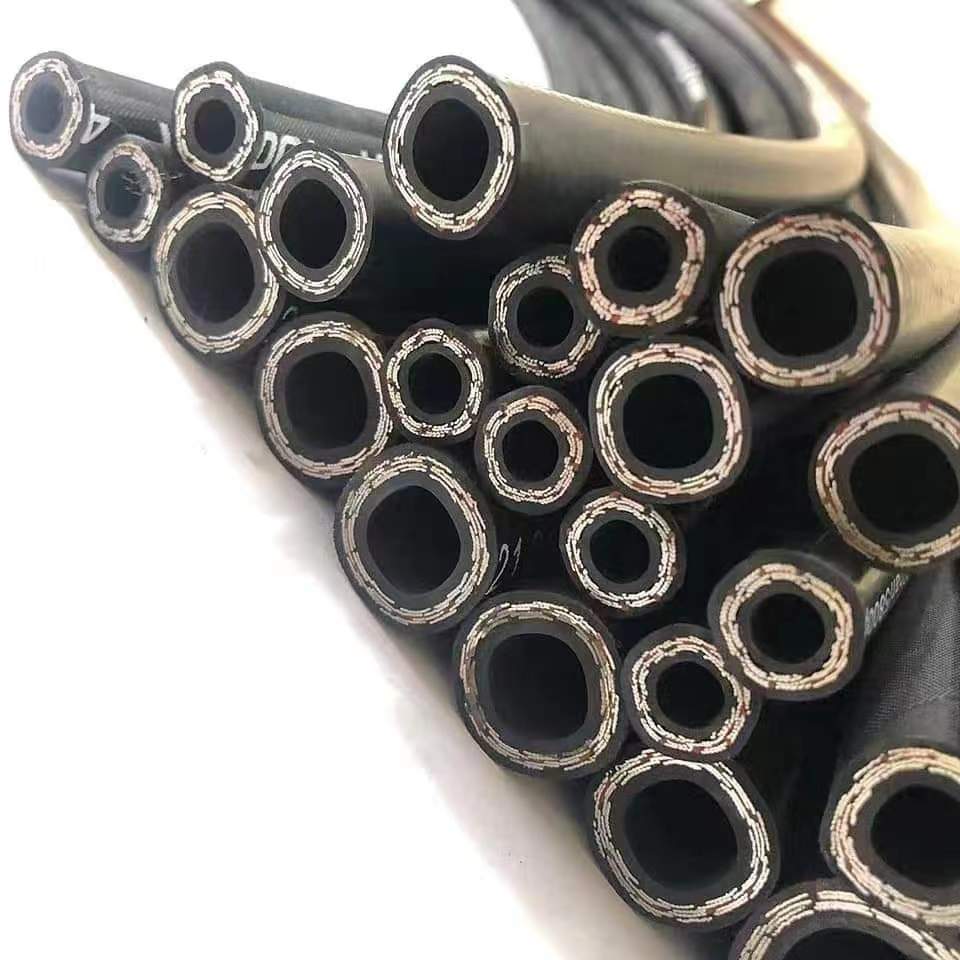
Hydraulic hoses are typically constructed from multiple layers, each contributing to specific performance characteristics. The inner tube, which directly contacts the hydraulic fluid, is commonly composed of synthetic rubbers like nitrile (NBR), ethylene propylene diene monomer (EPDM), or fluorocarbon (FKM – Viton®). NBR offers excellent resistance to petroleum-based fluids but limited temperature range. EPDM excels in high-temperature applications and resistance to water and steam, while FKM provides superior chemical resistance and temperature stability, albeit at a higher cost. The reinforcement layer provides burst strength and pressure resistance. Common materials include multiple plies of high-tensile steel wire, spirally wound steel wire, or aramid fiber braiding. Steel wire offers the highest strength, while aramid provides a lighter-weight alternative with good flexibility. The outer cover, providing abrasion, weather, and ozone resistance, is usually formulated from synthetic rubbers like chloroprene (CR – Neoprene®) or polyurethane.
Manufacturing processes vary based on hose type. For braided hoses, the inner tube is extruded, followed by the application of adhesive and the braiding of reinforcement wires using a high-speed braiding machine. Precise tension control during braiding is critical to ensure uniform pressure distribution and prevent premature failure. Spiral hose construction involves wrapping continuous steel wire around the inner tube, also with precisely controlled tension. Extruded hoses involve a similar process but utilize multiple layers of rubber compounds extruded simultaneously. Critical parameters during manufacturing include temperature control of the rubber compounds, die dimensions for extrusion, wire tension during braiding/spiraling, and adhesive bond strength between layers. Improper control leads to defects like porosity, uneven wall thickness, and delamination. Post-manufacturing processes include testing for burst pressure, impulse pressure, and dimensional accuracy.
Performance & Engineering
The performance of a hydraulic hose is governed by several key engineering principles. Burst pressure, the maximum pressure the hose can withstand before failure, is a critical safety parameter, dictated by reinforcement layer strength and hose diameter. Impulse pressure, representing cyclical pressure fluctuations, is a significant factor in fatigue life. High impulse pressures induce stress concentrations in the hose wall, leading to fatigue cracking over time. Hose flexibility, or bend radius, influences ease of installation and resistance to kinking. A smaller bend radius increases stress concentration and the potential for hose failure. Environmental resistance encompasses factors like temperature, ozone, UV exposure, and chemical compatibility. Prolonged exposure to extreme temperatures can degrade rubber compounds, reducing elasticity and strength. Ozone and UV radiation cause surface cracking and embrittlement. Chemical incompatibility leads to swelling, softening, or degradation of the inner tube, compromising fluid containment.
Force analysis plays a vital role in hose design. The internal pressure creates hoop stress in the hose wall, resisted by the reinforcement layer. External bending induces longitudinal stress and radial stress. Fittings contribute to stress concentration. Finite element analysis (FEA) is frequently employed to simulate stress distributions under various loading conditions, optimizing hose design for maximum performance and longevity. Compliance requirements vary by industry and region. For example, SAE J517 specifies performance requirements for hydraulic hoses used in mobile hydraulic machinery. EN 856 is the European standard for hydraulic hoses. These standards define testing procedures and acceptance criteria for burst pressure, impulse pressure, and other critical parameters.
Technical Specifications
| Parameter | Unit | SAE J517 - 100R2AT | EN 856 - 4SP |
|---|---|---|---|
| Working Pressure | MPa | 31.5 | 25 |
| Burst Pressure | MPa | 105 | 75 |
| Temperature Range | °C | -40 to +100 | -40 to +100 |
| Inner Tube | Material | Synthetic Rubber (NBR) | Synthetic Rubber (NBR) |
| Reinforcement | Material | Two Steel Wire Braids | Four Spiral Steel Wire |
| Outer Cover | Material | Synthetic Rubber (CR) | Synthetic Rubber (CR) |
Failure Mode & Maintenance
Hydraulic hose failures typically stem from several mechanisms. Fatigue cracking, induced by repeated pressure cycles and bending, is a common failure mode, particularly in high-impulse applications. The cracks initiate at stress concentration points, such as near fittings or at areas of localized damage. Abrasion, caused by external contact with abrasive surfaces, gradually wears away the outer cover, exposing the reinforcement layer to corrosion. Chemical attack, resulting from incompatibility with the hydraulic fluid, leads to swelling, softening, and degradation of the inner tube. Corrosion of the reinforcement wires weakens the hose structure, reducing its burst pressure. Improper installation, including excessive bending, twisting, or incorrect fitting selection, introduces stresses that accelerate failure.
Preventative maintenance is crucial for extending hose life and ensuring system safety. Regular visual inspections should identify signs of abrasion, cracking, bulging, or leakage. Hose bend radii should be checked to ensure compliance with manufacturer specifications. Fittings should be inspected for corrosion and tightness. Hydraulic fluid should be analyzed periodically for contamination and degradation. When replacing hoses, it’s critical to use fittings that are compatible with the hose material and pressure rating. Hoses should be stored in a cool, dry, and dark environment to prevent premature degradation. Crimping procedures must adhere to manufacturer guidelines to ensure a secure and leak-proof connection.
Industry FAQ
Q: What is the impact of using biodegradable hydraulic fluid on hose material selection?
A: Biodegradable hydraulic fluids, while environmentally friendly, often exhibit different chemical compatibility properties compared to traditional petroleum-based fluids. Certain biodegradable fluids can cause swelling or degradation of common hose materials like NBR. Therefore, using FKM (Viton®) or EPDM inner tubes is often recommended to ensure long-term compatibility and prevent premature hose failure. Thorough chemical compatibility testing is crucial before implementation.
Q: How do I determine the appropriate safety factor for a hydraulic hose application?
A: The appropriate safety factor depends on the criticality of the application and the potential consequences of failure. A safety factor of 4:1 is commonly used for general applications, meaning the burst pressure should be at least four times the maximum working pressure. For critical applications, such as those involving heavy machinery or personnel safety, a higher safety factor of 5:1 or even 6:1 may be warranted. Always consult relevant industry standards and manufacturer recommendations.
Q: What are the best practices for preventing hose twist during installation?
A: Hose twist significantly reduces hose life and can lead to premature failure. To prevent twisting, ensure the hose is free to rotate during installation. Avoid applying torque to the hose body when tightening fittings. Utilize swivel fittings where appropriate, allowing the hose to orient itself naturally. Carefully plan the hose routing to minimize bending and twisting.
Q: How does temperature affect the performance and lifespan of a hydraulic hose?
A: Temperature extremes significantly impact hose performance. High temperatures can cause rubber compounds to degrade, reducing elasticity and strength. Low temperatures can increase the viscosity of the hydraulic fluid, increasing pressure drop and stress on the hose. Selecting hose materials rated for the operating temperature range is critical. Consider using hoses with specialized temperature-resistant compounds for extreme environments.
Q: What are the key differences between braided and spiral hydraulic hoses, and when should each be used?
A: Braided hoses offer excellent flexibility and are suitable for applications with tight bend radii. They typically have lower pressure ratings compared to spiral hoses. Spiral hoses, constructed with a continuous wire helix, provide superior burst strength and impulse resistance, making them ideal for high-pressure, high-impulse applications. Spiral hoses are less flexible than braided hoses and generally require a larger bend radius.
Conclusion
Hydraulic oil hoses are essential components demanding rigorous material selection, precise manufacturing control, and diligent maintenance. Understanding the interplay between material properties, manufacturing processes, and operational conditions is paramount for ensuring optimal performance, reliability, and safety. The ongoing evolution of hydraulic fluids and system demands necessitates continuous innovation in hose technology, focusing on enhancing chemical compatibility, increasing pressure ratings, and reducing weight.
Future advancements will likely center around the development of smarter hoses incorporating sensors for real-time condition monitoring and predictive maintenance. Furthermore, advancements in composite materials offer the potential for lighter-weight, higher-strength hoses with improved fatigue resistance. Adherence to international standards and best practices remains crucial for ensuring the safety and longevity of hydraulic systems across diverse industrial applications.