
Apr . 01, 2024 17:55 Back to list
eaton hydraulic hose Performance Analysis

Introduction
Eaton hydraulic hose represents a critical component in fluid power systems across a diverse range of industrial applications, including construction, agriculture, manufacturing, and mining. Positioned within the hydraulic system as the conduit for pressurized fluid – typically hydraulic oil – it transmits power from the pump to actuators, enabling machinery operation. Core performance characteristics encompass pressure rating, temperature resistance, fluid compatibility, and flexibility. Unlike rigid piping, hydraulic hose allows for movement and vibration absorption, crucial for dynamic systems. The selection of an appropriate Eaton hydraulic hose is dictated by specific operational parameters, with failures leading to costly downtime and potential safety hazards. This guide provides a comprehensive technical overview of Eaton hydraulic hose, encompassing material science, manufacturing processes, performance considerations, failure modes, and relevant industry standards.
Material Science & Manufacturing
Eaton hydraulic hoses are constructed from a multi-layered composition, each layer contributing to specific performance attributes. The inner tube, in direct contact with the hydraulic fluid, is typically composed of synthetic rubber compounds such as nitrile rubber (NBR), ethylene propylene diene monomer (EPDM), or fluorocarbon (FKM/Viton). NBR offers good resistance to petroleum-based fluids, EPDM excels in phosphate ester fluids and high-temperature applications, while FKM provides superior chemical resistance and temperature stability. Reinforcement layers provide the hose’s strength and pressure handling capability. These layers traditionally utilize multiple braids of high-tensile steel wire, although synthetic fiber reinforcements (aramid or polyester) are increasingly common in lower-pressure applications, offering weight reduction and increased flexibility. The cover layer, often a synthetic rubber compound like chloroprene (CR), provides abrasion resistance, weathering protection, and chemical resistance.
Manufacturing processes vary depending on hose type and construction. Inner tubes are extruded through a die, creating a seamless layer. Reinforcement braids are wound helically around the inner tube using automated braiding machines, with precise control of braid angle and tension being critical for pressure containment. Following reinforcement, the hose undergoes curing (vulcanization) – a chemical process that cross-links the rubber polymers, enhancing their elasticity, strength, and resistance to degradation. The cover is then extruded over the reinforced tube and similarly cured. Critical parameter control during manufacturing includes rubber compound mixing ratios, extrusion temperatures, braid tension, and curing time/temperature cycles. Quality control procedures incorporate dimensional checks, pressure testing to specified burst pressures, and impulse testing to evaluate fatigue resistance. Post-manufacturing processes often include skiving (removing a layer of the cover to facilitate fitting attachment) and fitting application using specialized crimping equipment.
Performance & Engineering
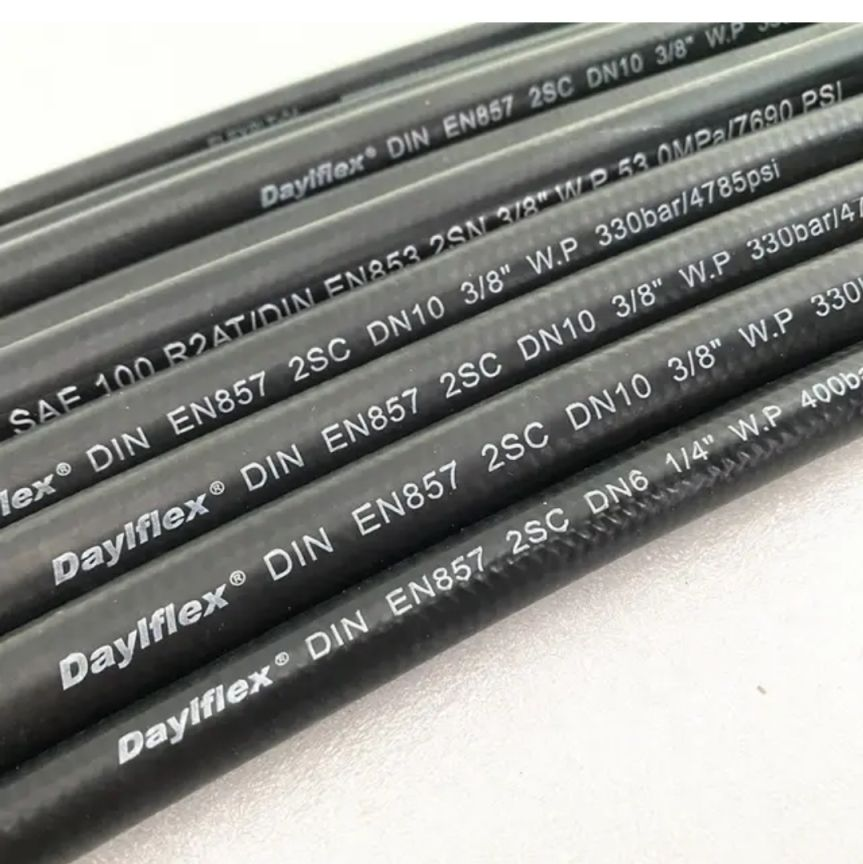
The performance of Eaton hydraulic hose is governed by several key engineering principles. Hose pressure ratings are determined based on a safety factor applied to the burst pressure. Burst pressure is the pressure at which the hose fails catastrophically. Working pressure is significantly lower, typically 50-75% of the burst pressure, providing a safety margin. Hose flexibility is crucial for installation in confined spaces and accommodating system movement. Bend radius – the minimum radius to which the hose can be bent without kinking or damaging the reinforcement – is a critical specification. Impulse pressure, referring to pressure fluctuations within the hydraulic system, induces cyclic stresses in the hose. Fatigue life – the number of pressure cycles the hose can withstand before failure – is a key performance indicator. Temperature extremes affect material properties; high temperatures can accelerate rubber degradation, while low temperatures can reduce flexibility and increase brittleness. Fluid compatibility is paramount; incompatible fluids can cause swelling, softening, or cracking of the inner tube.
Engineering considerations involve force analysis under pressure, accounting for hoop stress in the hose wall and axial stress due to pressure loads. Finite element analysis (FEA) is often employed to optimize hose design and predict stress distribution. Compliance requirements, dictated by industry standards, mandate specific testing procedures and performance criteria. Functional implementation requires proper hose routing, avoiding sharp bends and abrasive surfaces. Hose assemblies, including fittings, must be properly crimped to ensure a leak-free and mechanically secure connection.
Technical Specifications
| Hose Type | Working Pressure (PSI) | Burst Pressure (PSI) | Temperature Range (°F) |
|---|---|---|---|
| 1A (NBR Inner Tube, 2 Wire Braid) | 2000 | 8000 | -40 to 212 |
| 1SC (EPDM Inner Tube, 1 Wire Braid) | 1500 | 6000 | -40 to 250 |
| 4SH (NBR Inner Tube, 4 Spiral Wire) | 3000 | 12000 | -40 to 212 |
| 50AT (FKM Inner Tube, 2 Wire Braid) | 3000 | 12000 | -40 to 275 |
| XE Series (Synthetic Rubber, Spiral Reinforcement) | 4500 | 18000 | -40 to 250 |
| UltraSpir Series (Synthetic Rubber, Extreme Spiral Reinforcement) | 5000 | 20000 | -40 to 275 |
Failure Mode & Maintenance
Eaton hydraulic hose failure modes are diverse and often interconnected. Fatigue cracking, resulting from repeated pressure cycling, is a common failure mechanism, initiating at areas of high stress concentration (e.g., near fittings, bends). Delamination, the separation of reinforcement layers, occurs due to inadequate bonding between layers or degradation of the bonding agent. Abrasion, caused by external contact with abrasive surfaces, weakens the cover and can lead to reinforcement exposure. Chemical degradation, due to incompatible fluids, results in swelling, softening, or cracking of the inner tube. Oxidation, accelerated by high temperatures and exposure to oxygen, causes rubber hardening and loss of flexibility. Kinking, caused by exceeding the minimum bend radius, damages the reinforcement and restricts flow. Fitting failure, including corrosion and loosening, can lead to leaks and hose rupture.
Preventative maintenance is crucial for extending hose life. Regular visual inspections should identify abrasions, cracks, leaks, and kinks. Hose routing should be optimized to minimize bending and contact with abrasive surfaces. Fluid cleanliness is paramount; filtration systems should be employed to remove contaminants. Proper fitting installation, using calibrated crimping equipment, ensures a secure connection. Periodic pressure testing can detect gradual deterioration. When replacing hoses, always use hoses with appropriate pressure ratings and fluid compatibility. Document hose replacement dates and inspection findings for tracking purposes.
Industry FAQ
Q: What is the difference between a 2-wire braid and a 4-spiral hose, and when would I choose one over the other?
A: A 2-wire braid hose offers good flexibility and is suitable for moderate pressure applications. A 4-spiral hose provides significantly higher pressure capacity and kink resistance, making it ideal for demanding applications with high pressures or frequent movement. The 4-spiral construction utilizes a heavier reinforcement layer, enhancing its ability to withstand pressure spikes and maintain its shape.
Q: How does temperature affect hydraulic hose performance?
A: Extreme temperatures can significantly impact hose performance. High temperatures accelerate rubber degradation, reducing flexibility and pressure capacity. Low temperatures can make the rubber brittle and more susceptible to cracking. It’s crucial to select a hose with a temperature range that matches the operating conditions of the hydraulic system.
Q: What fluid compatibility considerations are important when selecting a hydraulic hose?
A: Fluid compatibility is critical. Using an incompatible fluid can cause the inner tube to swell, soften, or crack, leading to leaks and failure. Refer to Eaton’s fluid compatibility charts to ensure the hose material is compatible with the hydraulic fluid being used. Different hose materials (NBR, EPDM, FKM) offer varying levels of resistance to different fluids.
Q: What is the proper procedure for crimping hose fittings?
A: Proper crimping is essential for a leak-free and secure connection. It requires using a calibrated crimping machine and the correct die set for the hose and fitting combination. Incorrect crimping can lead to premature failure. Over-crimping can damage the hose reinforcement, while under-crimping can result in leaks.
Q: How often should I inspect my hydraulic hoses?
A: Regular inspection is vital. A visual inspection should be performed at least monthly, and more frequently in harsh environments. Look for signs of abrasion, cracking, leaks, kinks, and loose fittings. Maintain a detailed inspection log to track hose condition and replacement dates.
Conclusion
Eaton hydraulic hose constitutes a critical component within hydraulic systems, demanding careful consideration of material science, manufacturing precision, and operational parameters. The selection process necessitates a thorough understanding of pressure requirements, temperature ranges, fluid compatibility, and environmental conditions. Effective preventative maintenance, encompassing regular inspections and adherence to proper installation procedures, is paramount for ensuring long-term reliability and minimizing the risk of catastrophic failure.
Continued advancements in hydraulic hose technology focus on enhancing durability, reducing weight, and improving fluid resistance. The development of new materials and manufacturing processes will continue to drive performance improvements, ultimately contributing to increased efficiency and safety in a wide range of industrial applications. Understanding the nuances of Eaton hydraulic hose technology is vital for procurement professionals, maintenance engineers, and system designers alike.