
Apr . 01, 2024 17:55 Back to list
competitive price hydraulic hose Performance Analysis
Introduction
Hydraulic hose, specifically competitive price hydraulic hose, constitutes a critical component within fluid power systems, facilitating the transmission of pressurized hydraulic fluid to actuate machinery across diverse industrial sectors. Its technical position in the industry chain lies between the manufacturing of raw materials (rubber, steel wire, synthetic polymers) and the assembly of complete hydraulic systems, serving as the vital conduit connecting pumps, valves, and actuators. Core performance characteristics center around its ability to withstand high pressures, resist abrasion and environmental degradation, and maintain volumetric expansion limits, directly influencing system efficiency and reliability. The challenge in this segment lies in balancing performance with cost, making material selection, manufacturing precision, and quality control paramount for producing competitive price solutions without compromising safety or longevity. This guide will detail the material science, manufacturing processes, performance engineering, potential failure modes, and relevant industry standards associated with this crucial component.
Material Science & Manufacturing
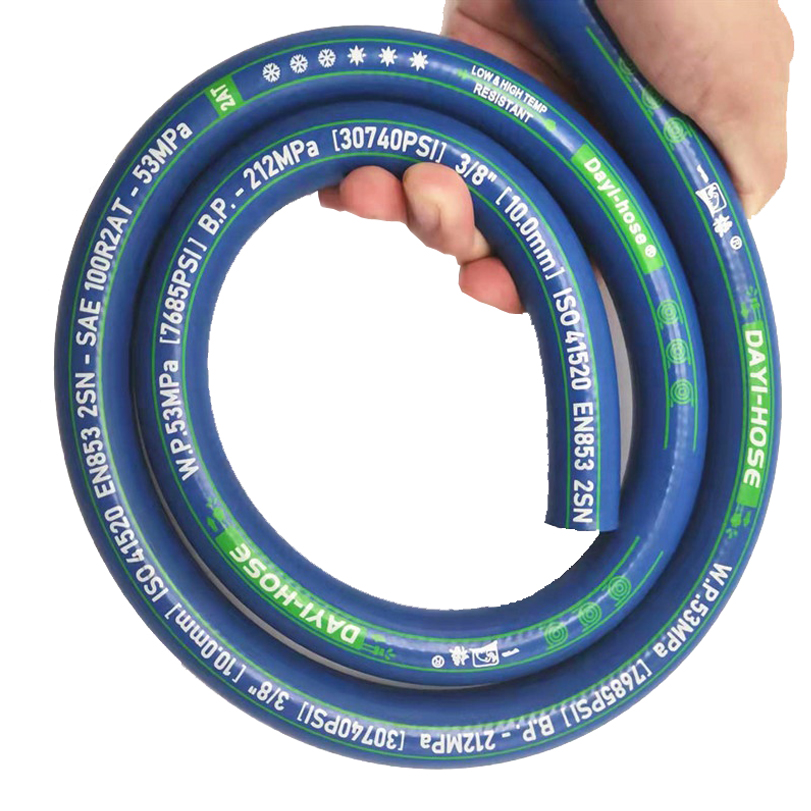
Competitive price hydraulic hose construction typically relies on several key materials. The inner tube, providing fluid resistance, is commonly composed of synthetic rubbers like nitrile (NBR), chloroprene (CR – Neoprene), or ethylene propylene diene monomer (EPDM). NBR offers good oil resistance but limited temperature range; CR provides broader temperature capability and resistance to ozone; and EPDM excels in resistance to water, heat, and weathering. Reinforcement layers, critical for pressure containment, are usually high-tensile steel wire, often spiraled or braided. The number of layers dictates the hose’s working pressure rating. The outer cover, protecting against abrasion, weather, and chemical attack, frequently employs a blend of synthetic rubbers like CR or polyurethane (PU).
Manufacturing processes begin with the extrusion of the inner tube. Precise control of polymer composition, temperature, and die geometry is crucial to ensure consistent wall thickness and smooth bore. Reinforcement layers are then applied, often through a helical winding process. Steel wire tension and pitch are meticulously controlled to achieve the desired pressure rating and flexibility. Following reinforcement, the outer cover is extruded over the assembly. Curing, or vulcanization, is a critical step involving heat and pressure, crosslinking the rubber polymers to enhance strength, elasticity, and chemical resistance. Quality control incorporates burst pressure testing, impulse testing (simulating pressure pulsations), and dimensional inspections. Low-cost hoses may utilize less expensive rubber compounds or fewer reinforcement layers, impacting performance and lifespan. Parameter control during extrusion, winding, and curing significantly impacts hose quality – variations in temperature, pressure, or material feed rates can lead to defects such as voids, uneven wall thickness, or insufficient curing.
Performance & Engineering
The performance of hydraulic hose is fundamentally governed by principles of fluid mechanics and material strength. Working pressure is determined by the hose's burst pressure divided by a safety factor (typically 4:1). Force analysis considers both static and dynamic loading conditions. Impulse pressures, caused by pump pulsations and valve switching, induce cyclic stresses on the hose reinforcement, potentially leading to fatigue failure. Hose flexibility, quantified by bend radius, is critical for installation and operation, influencing stress concentrations at the bend. Environmental resistance is vital; exposure to extreme temperatures, UV radiation, ozone, and corrosive fluids can degrade rubber compounds, reducing flexibility and strength.
Compliance requirements vary by industry and region. SAE J517, a widely adopted standard, defines performance criteria for hydraulic hose, including pressure rating, temperature range, and impulse cycle life. EN 853 and EN 857 are European standards with similar requirements. Selecting the appropriate hose for a given application requires careful consideration of operating pressure, fluid compatibility, temperature range, and environmental factors. Finite element analysis (FEA) is often employed to optimize hose design and predict stress distributions under various loading conditions. Proper hose routing and support are essential to minimize bending stresses and prevent abrasion. End fitting selection and crimping procedures are critical to ensure a secure and leak-free connection.
Technical Specifications
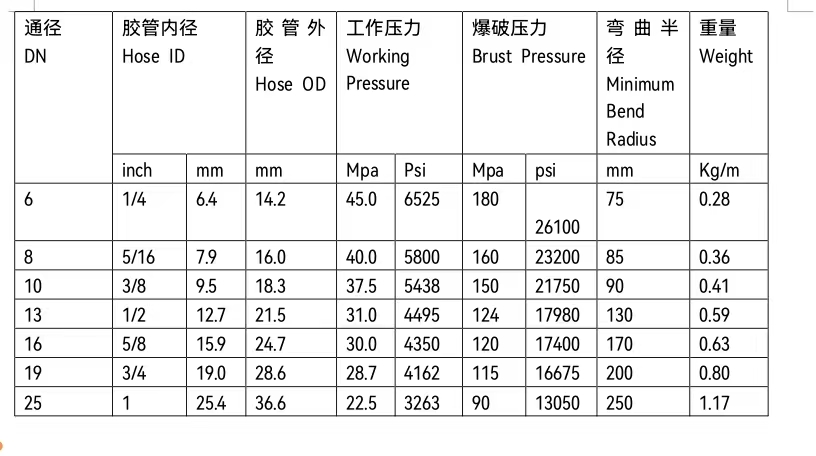
| Parameter | Unit | Typical Value (NBR Inner/Steel Wire Reinforcement/CR Cover) | Impact on Performance |
|---|---|---|---|
| Working Pressure | MPa | 20-35 | Determines maximum allowable system pressure. |
| Burst Pressure | MPa | 80-140 | Safety margin; indicates hose’s ultimate strength. |
| Temperature Range | °C | -40 to +100 | Affects rubber compound flexibility and degradation rate. |
| Inner Tube Material | - | Nitrile (NBR) | Dictates fluid compatibility and temperature resistance. |
| Reinforcement Layers | Number | 2-6 | Controls pressure rating and flexibility. |
| Outer Cover Material | - | Chloroprene (CR) | Provides abrasion, weather, and chemical resistance. |
Failure Mode & Maintenance
Hydraulic hose failures commonly manifest in several forms. Fatigue cracking, resulting from repeated pressure pulsations and bending stresses, is a frequent cause of failure, often initiating at the reinforcement layer. Abrasion, caused by contact with abrasive surfaces, can wear through the outer cover, exposing the reinforcement to corrosion. Hose kinking, resulting from excessive bending, can damage the inner tube and reduce flow. Chemical attack by incompatible fluids can degrade rubber compounds, leading to swelling, cracking, or loss of flexibility. Improper crimping of end fittings can create leak paths or weaken the connection. Oxidation, particularly in the outer cover exposed to UV radiation and ozone, causes hardening and cracking.
Preventative maintenance is crucial. Regular visual inspections should identify signs of abrasion, cracking, swelling, or leaks. Hose routing should minimize bending stresses and protect against abrasion. Fluid compatibility should be verified before use. End fittings should be inspected for proper crimping and tightness. Hose replacement should be performed based on manufacturer recommendations or when signs of degradation are observed. If a hose fails, a thorough failure analysis should be conducted to identify the root cause and prevent recurrence. Proper storage of hoses, away from direct sunlight and extreme temperatures, is also essential to prolong their lifespan.
Industry FAQ
Q: What is the impact of steel wire construction (spiral vs. braided) on hose performance and cost?
A: Spiral wire reinforcement generally offers higher pressure ratings and greater flexibility compared to braided construction. Braided hose tends to be more resistant to kinking. Spiral wire hose is typically more expensive due to the complexity of the winding process. The choice depends on the specific application requirements – high pressure and tight bend radii favor spiral wire, while resistance to kinking and lower cost may favor braided.
Q: How does fluid compatibility impact hose selection and longevity?
A: Incompatible fluids can cause swelling, cracking, or degradation of the inner tube material. For example, using a NBR hose with phosphate ester hydraulic fluid will result in rapid deterioration. Careful selection of the inner tube material based on fluid type is critical. Consult compatibility charts provided by hose manufacturers to ensure proper material selection.
Q: What are the key considerations for determining hose replacement intervals?
A: Replacement intervals should be based on a combination of factors: manufacturer recommendations, operating conditions (pressure, temperature, exposure to chemicals), and visual inspection findings. Signs of degradation such as cracking, abrasion, swelling, or leaks warrant immediate replacement. Regular preventative maintenance and record-keeping are essential.
Q: What role does the outer cover play beyond abrasion protection?
A: The outer cover provides protection against environmental factors such as UV radiation, ozone, and weathering, which can degrade the reinforcement and rubber compounds. It also resists oil and chemical splashes. The cover material affects the hose's overall durability and lifespan.
Q: What are the common causes of hose leaks at the crimped fittings?
A: Leaks at crimped fittings can result from improper crimping procedures, damaged fittings, or corrosion. Using the correct die size and crimping pressure is critical. Inspect fittings for corrosion or damage before installation. Ensure fittings are compatible with the hose and fluid being used.
Conclusion
The selection and maintenance of competitive price hydraulic hose are paramount to the reliable and safe operation of hydraulic systems. A comprehensive understanding of material science, manufacturing processes, performance characteristics, and potential failure modes is crucial for informed decision-making. Balancing cost with performance requires careful consideration of operating conditions and fluid compatibility, prioritizing material selection and quality control measures.
Ongoing preventative maintenance, including regular visual inspections and adherence to manufacturer recommendations, significantly extends hose lifespan and minimizes the risk of catastrophic failure. Embracing industry standards such as SAE J517 and EN 853 ensures compatibility and safety, while continuous advancements in material science and manufacturing techniques offer opportunities to enhance hose performance and durability, ultimately contributing to increased system efficiency and reduced downtime.