
Apr . 01, 2024 17:55 Back to list
china smooth cover steel wire braided hydraulic hose Performance Analysis

Introduction
China smooth cover steel wire braided hydraulic hose represents a critical component in fluid power systems across diverse industrial applications. Positioned within the hydraulic system supply chain as a final element conveying pressurized fluid, its performance directly influences system efficiency, reliability, and safety. These hoses are constructed with an inner tube engineered for fluid compatibility, multiple layers of high-tensile steel wire reinforcement for pressure resistance, and a smooth, abrasion-resistant outer cover. Key performance characteristics include working pressure, burst pressure, temperature range, and fluid compatibility. The increasing demand for higher operating pressures and extended service life in sectors like construction, agriculture, and manufacturing drives continuous advancements in material science and manufacturing processes related to these hoses. A key industry pain point revolves around maintaining consistent quality control to ensure predictable performance and prevent catastrophic failures in high-stress applications.
Material Science & Manufacturing
The constituent materials of china smooth cover steel wire braided hydraulic hose dictate its overall performance characteristics. The inner tube is typically composed of synthetic rubbers, specifically nitrile rubber (NBR), chlorinated polyethylene rubber (CM), or fluoroelastomers (FKM, Viton) depending on the conveyed fluid. NBR offers good resistance to petroleum-based fluids, CM excels in heat and ozone resistance, and FKM provides superior chemical resistance, but at a higher cost. The reinforcing layers utilize high-tensile steel wire, generally drawn from carbon steel and surface treated to enhance adhesion to the rubber matrix and resist corrosion. The cover material, commonly a blend of synthetic rubbers like SBR (styrene-butadiene rubber) and additives, provides abrasion, weather, and ozone resistance.
Manufacturing commences with inner tube extrusion, where the chosen rubber compound is forced through a die to create a seamless tube. Subsequently, the steel wire reinforcement is spirally wound around the inner tube with precise tension control, influencing the hose’s flexibility and pressure capacity. Multiple layers of wire braiding are applied to achieve the desired pressure rating. A bonding agent is applied between the inner tube, wire reinforcement, and outer cover to ensure robust adhesion, crucial for preventing separation under pressure. Finally, the outer cover is extruded, and the hose undergoes curing (vulcanization) at elevated temperatures to crosslink the rubber polymers, enhancing their strength and elasticity. Critical parameters during manufacturing include wire tension consistency, bonding agent application uniformity, curing time and temperature, and dimensional accuracy. Post-production, hoses are subjected to rigorous hydraulic pressure testing and dimensional inspections to verify conformance to specifications.
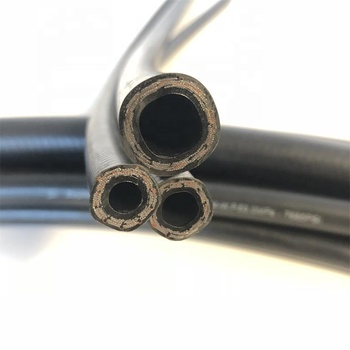
Performance & Engineering
Performance evaluation of steel wire braided hydraulic hose centers around its ability to withstand internal pressure, external damage, and environmental factors. Force analysis involves calculating hoop stress in the inner tube and tension in the steel wire reinforcement under pressurized conditions. The burst pressure, typically four times the working pressure, represents the ultimate failure point. Environmental resistance is assessed through exposure to temperature extremes, UV radiation, ozone, and various fluids. Compliance requirements dictate adherence to industry standards like SAE J517 (hydraulic hose performance), ISO 6898 (hydraulic hose assemblies), and EN 856 (hydraulic hose).
Engineering considerations include hose flexibility, bend radius, and fatigue life. A tighter bend radius increases stress concentration at the bend, potentially leading to premature failure. Fatigue life is determined by subjecting the hose to cyclical pressure loading, simulating real-world operating conditions. Proper hose assembly, utilizing correctly sized fittings and crimping procedures, is paramount to ensure a leak-free and structurally sound connection. Incorrect crimping can lead to fitting slippage or hose rupture. Furthermore, the hose's compatibility with the conveyed fluid must be verified to prevent swelling, degradation, or leaching of harmful substances. The selection of appropriate hose construction based on fluid type, operating pressure, temperature, and application is critical for ensuring long-term reliability and safety.
Technical Specifications
| Parameter | Unit | SAE J517 R1AT | SAE J517 R2AT |
|---|---|---|---|
| Working Pressure | MPa | 20.7 | 27.6 |
| Burst Pressure | MPa | 82.7 | 110.3 |
| Temperature Range | °C | -40 to +100 | -40 to +121 |
| Inner Tube | Material | NBR | NBR |
| Reinforcement | Layers | 2 Spiral Wire | 4 Spiral Wire |
| Cover | Material | SBR | SBR |
Failure Mode & Maintenance
Failure modes in steel wire braided hydraulic hose commonly include burst due to exceeding the working pressure, fatigue cracking from cyclical loading, abrasion damage to the outer cover, and fitting failure. Burst failures often originate from defects in the inner tube or wire reinforcement. Fatigue cracking typically initiates at stress concentration points, such as at the ends of the hose or at points of severe bending. Abrasion damage can compromise the integrity of the cover, exposing the reinforcement to corrosion. Fitting failures stem from improper crimping, corrosion, or material incompatibility.
Preventative maintenance is crucial for extending hose life and preventing catastrophic failures. Regular visual inspections should be conducted to identify any signs of abrasion, cracking, or swelling. Hoses should be routed to avoid sharp bends and contact with hot surfaces or abrasive materials. Fluid contamination should be minimized through the use of filtration systems. When replacing hoses, it is essential to use compatible fittings and ensure proper crimping. Hose assemblies should be periodically pressure tested to verify their integrity. If any signs of damage or deterioration are observed, the hose should be replaced immediately. Proper storage, away from direct sunlight and extreme temperatures, is also vital for maintaining hose flexibility and preventing premature aging.
Industry FAQ
Q: What is the impact of fluid velocity on the lifespan of a steel wire braided hose?
A: Higher fluid velocities can exacerbate erosion of the inner tube, particularly with abrasive fluids or suspended particles. This erosion thins the inner tube wall, reducing its burst pressure and increasing the risk of failure. Additionally, increased velocity generates more heat, potentially degrading the rubber compounds over time. Selecting a hose with a larger inner diameter to reduce velocity is a mitigation strategy.
Q: How does the type of steel wire used in the reinforcement affect hose performance?
A: The tensile strength and corrosion resistance of the steel wire are critical. High-tensile steel wire provides greater pressure capacity and fatigue life. Surface treatments, such as zinc coating or passivation, enhance corrosion resistance, preventing wire degradation and maintaining hose integrity. Different wire gauges and lay angles also influence flexibility and pressure ratings.
Q: What are the key considerations when selecting a hose cover material?
A: The cover material must resist abrasion, ozone degradation, weathering, and chemical attack from external sources. SBR is a common choice for general-purpose applications, while EPDM offers superior ozone and weather resistance. Specific applications may require specialized cover materials like polyurethane for enhanced abrasion resistance or Viton for chemical resistance.
Q: What is the role of the bonding agent in hose construction?
A: The bonding agent is critical for ensuring adhesion between the inner tube, steel wire reinforcement, and outer cover. Without adequate bonding, the layers can separate under pressure, leading to hose failure. The bonding agent must be compatible with all hose materials and maintain its integrity over the hose’s operating temperature range.
Q: How do I determine the correct hose length for my application?
A: Hose length should account for the straight-line distance between connection points, plus allowances for bends, fittings, and potential movement or vibration. Excessive length can lead to hose kinking and increased pressure drop, while insufficient length can overstress the hose and fittings. It's advisable to consult hose length calculation guides or work with a hydraulic hose specialist.
Conclusion
China smooth cover steel wire braided hydraulic hose serves as a vital link in hydraulic power transmission systems. Its performance is fundamentally dictated by the synergistic interaction of material science, rigorous manufacturing control, and adherence to stringent industry standards. Understanding the principles of force analysis, environmental resistance, and potential failure modes is crucial for ensuring safe and reliable operation. Selecting the appropriate hose construction based on the specific application demands—considering fluid compatibility, operating pressure, temperature, and environmental factors—is paramount to maximizing service life and minimizing downtime.
Future advancements will likely focus on developing new rubber compounds with enhanced chemical and temperature resistance, exploring alternative reinforcement materials like high-strength fibers, and implementing smart hose technologies with integrated sensors for real-time pressure and temperature monitoring. Continued investment in quality control and testing procedures will be essential for maintaining the integrity and reliability of these critical components within increasingly demanding industrial environments.