
Apr . 01, 2024 17:55 Back to list
china single fiber braid hydraulic hose Performance Analysis

Introduction
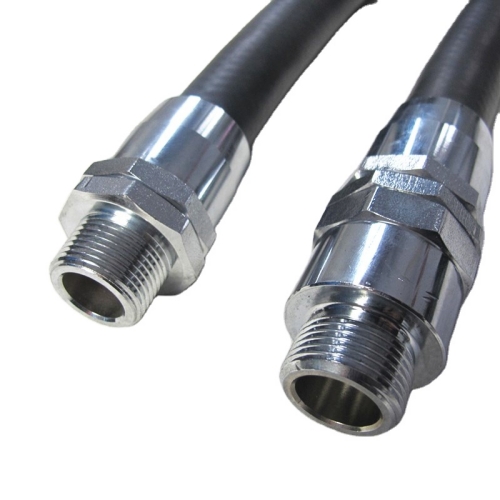
China single fiber braid hydraulic hose represents a critical component in fluid power systems across diverse industrial applications. Positioned within the hydraulic system as the conduit for pressurized fluid—typically hydraulic oil—these hoses facilitate the transmission of power between pumps, valves, actuators, and other essential components. Their technical importance stems from their ability to reliably withstand high pressures, resist abrasion and chemical attack, and maintain flexibility under dynamic operating conditions. A single fiber braid construction, employing high-tensile strength synthetic fibers embedded within a rubber matrix, provides a cost-effective balance between performance and durability. Core performance characteristics include burst pressure, working pressure, temperature range, and fluid compatibility. Unlike multi-spiral reinforced hoses, single braid hoses are generally suited for moderate-pressure applications requiring greater flexibility, making them common in agricultural machinery, material handling equipment, and certain industrial machinery applications. The industry currently faces challenges related to consistently achieving high-quality synthetic fiber distribution within the rubber matrix, maintaining dimensional stability across varying temperatures, and complying with increasingly stringent environmental regulations regarding phthalate content and volatile organic compound (VOC) emissions.
Material Science & Manufacturing
The core materials in china single fiber braid hydraulic hose construction primarily include a synthetic rubber inner tube, a reinforcing fiber braid, and a protective outer cover. The inner tube commonly employs materials like styrene-butadiene rubber (SBR) for oil resistance, nitrile rubber (NBR) for improved petroleum-based fluid compatibility, or ethylene propylene diene monomer (EPDM) for phosphate ester fluid resistance. NBR, with its acrylonitrile content, exhibits varying levels of oil resistance dependent on the percentage of acrylonitrile. Higher percentages generally improve resistance but reduce flexibility at low temperatures. The reinforcing braid is typically composed of high-tensile polyester, nylon 6, or aramid fibers. Polyester offers good dimensional stability and resistance to stretching, while nylon 6 provides excellent abrasion resistance and fatigue strength. Aramid fibers, while significantly stronger, are more expensive and susceptible to degradation in humid environments. The outer cover material is often a chloroprene rubber (CR) blend, providing resistance to abrasion, ozone, and weathering. Manufacturing begins with the extrusion of the inner tube to the specified bore diameter and wall thickness. The fiber braid is then applied using a high-speed braiding machine, carefully controlling braid angle (typically 55-70 degrees) and fiber tension to ensure uniform reinforcement. Critical parameters include braid coverage (percentage of hose circumference covered by fibers) and fiber count per inch. Post-braiding, the hose assembly undergoes vulcanization, a process involving heating under pressure to cross-link the rubber molecules and bond the braid to the inner and outer layers. Vulcanization parameters – temperature, time, and pressure – are tightly controlled to optimize physical properties like tensile strength, elongation, and hardness. Quality control measures include dimensional checks, pressure testing to burst and impulse, and fiber content analysis.
Performance & Engineering
The performance of a single fiber braid hydraulic hose is governed by several engineering principles. Burst pressure is determined by the tensile strength of the reinforcement braid and the adhesion between the braid and the rubber matrix, following a hoop stress calculation. Working pressure is typically a fraction (safety factor, often 4:1) of the burst pressure, accounting for dynamic loads and fatigue. Impulse pressure resistance—the ability to withstand pressure surges—relies on the elasticity of the rubber and the damping effect of the fiber braid. Hose flexibility, critical for installation and operation, is influenced by the inner tube compound, braid structure, and outer cover stiffness. Force analysis involves calculating the bending stress induced by hose curvature and the axial stress caused by internal pressure. Environmental resistance is paramount. Exposure to extreme temperatures can cause rubber hardening or softening, impacting flexibility and pressure rating. UV radiation degrades the outer cover, leading to cracking and loss of protective properties. Chemical compatibility must be considered based on the hydraulic fluid used; incompatible fluids can cause swelling, softening, or cracking of the rubber components. Compliance requirements vary by region, but typically include adherence to SAE J517 (hydraulic hose specifications), ISO 6898 (hydraulic systems general safety requirements), and RoHS directives regarding hazardous substance restriction. Finite element analysis (FEA) is increasingly employed to model hose behavior under load, optimizing braid design and rubber compound selection for improved performance and longevity.
Technical Specifications
| Parameter | Unit | Typical Value (SAE 100R1 Equivalent) | Testing Standard |
|---|---|---|---|
| Working Pressure | MPa | 10 | SAE J517 |
| Burst Pressure | MPa | 30 | SAE J517 |
| Inner Tube Material | - | NBR (Nitrile Rubber) | ASTM D2000 |
| Reinforcement Braid | - | Polyester Fiber (1SP) | SAE J517 |
| Outer Cover Material | - | CR (Chloroprene Rubber) | ASTM D2000 |
| Temperature Range | °C | -40 to +100 | SAE J517 |
Failure Mode & Maintenance
Single fiber braid hydraulic hoses are susceptible to several failure modes. Fatigue cracking, initiated by repeated flexing and pressure cycling, often begins at the braid-to-rubber interface. Delamination, the separation of the hose layers, can occur due to inadequate adhesion during vulcanization or prolonged exposure to aggressive fluids. Abrasion, particularly on the outer cover, weakens the hose and can expose the reinforcing braid to corrosion. Oxidation of the rubber components, accelerated by heat and oxygen exposure, leads to hardening, cracking, and loss of elasticity. Pinholes and leaks can develop due to localized damage from external objects or internal corrosion. Failure analysis should involve visual inspection for cracks, bulges, or abrasions; pressure testing to identify leaks; and microscopic examination of fractured surfaces to determine the root cause. Preventive maintenance includes regular visual inspections, checking for signs of wear or damage, and ensuring proper routing to avoid excessive bending or abrasion. Hoses should be replaced at recommended intervals based on operating conditions and fluid compatibility. Proper storage is crucial; hoses should be stored in a cool, dry place away from direct sunlight and ozone sources. When disconnecting hoses, avoid sharp bends and utilize appropriate tools to prevent damage to the fittings. Periodic fluid analysis can detect contaminants that accelerate hose degradation.
Industry FAQ
Q: What is the impact of varying braid angles on hose performance?
A: Braid angle significantly affects hose flexibility and burst pressure. Shallower braid angles (e.g., 30-45 degrees) result in greater flexibility but lower burst pressure, as the load is distributed over a wider area. Steeper braid angles (e.g., 60-75 degrees) provide higher burst pressure but reduced flexibility, concentrating the load along the braid fibers. The optimal braid angle is a compromise dependent on the intended application.
Q: How does fluid temperature affect the service life of NBR inner tubes?
A: Elevated temperatures accelerate the degradation of NBR, leading to softening, swelling, and reduced tensile strength. Prolonged exposure to temperatures exceeding 100°C can significantly shorten the hose's service life. Conversely, low temperatures can cause NBR to become brittle and less flexible. Selecting an inner tube material with a wider operating temperature range, such as EPDM, may be necessary for extreme temperature applications.
Q: What are the implications of using non-compatible hydraulic fluids with a standard NBR hose?
A: Incompatible fluids can cause significant damage to the NBR inner tube. For example, exposure to ketones or aldehydes can lead to rapid swelling and degradation, resulting in hose failure. Phosphate ester fluids require specialized EPDM inner tubes to prevent premature deterioration. Always consult a fluid compatibility chart before selecting a hose for a specific application.
Q: How can I identify signs of impending hose failure before a catastrophic event?
A: Regularly inspect hoses for cracks, abrasions, bulges, or leaks. Pay close attention to fittings for signs of corrosion or loosening. Listen for unusual noises during operation, which could indicate internal damage. Perform pressure testing if any concerns arise. Implement a preventative maintenance schedule with documented inspection intervals.
Q: What is the role of the outer cover in protecting the hose from environmental factors?
A: The outer cover provides crucial protection against abrasion, ozone, UV radiation, and chemical splashes. A damaged or deteriorated outer cover can expose the reinforcing braid to corrosion and accelerate the degradation of the underlying rubber layers. Regular inspection and replacement of the outer cover, if feasible, can significantly extend the hose's service life.
Conclusion
China single fiber braid hydraulic hose remains a widely used and cost-effective solution for numerous hydraulic applications. Its performance is intricately linked to material selection, manufacturing precision, and adherence to industry standards. Understanding the underlying engineering principles – force analysis, fluid compatibility, and environmental resistance – is paramount for ensuring reliable and safe operation. Addressing the industry's ongoing challenges surrounding material consistency, dimensional stability, and regulatory compliance will be crucial for continued advancement.
Future development is likely to focus on enhancing hose durability through innovative rubber compounds, optimizing braid structures for improved fatigue resistance, and incorporating smart sensing technologies for real-time condition monitoring. The trend towards sustainable materials and manufacturing processes will also drive innovation in this sector, promoting environmentally responsible hose designs and reducing the overall environmental footprint.