
Apr . 01, 2024 17:55 Back to list
oem production ptfe hose manufacturers Performance Analysis

Introduction
Polytetrafluoroethylene (PTFE) hose, commonly referred to as Teflon hose, represents a critical component in numerous industrial applications demanding exceptional chemical resistance, high-temperature performance, and non-stick properties. OEM production of PTFE hose involves a specialized manufacturing process catering to bespoke requirements, distinguishing it from standard hose offerings. This guide provides a comprehensive technical overview of PTFE hose, focusing on the intricacies of OEM manufacturing, material science, performance characteristics, potential failure modes, and applicable industry standards. The increasing demand for PTFE hose is driven by the stringent requirements of industries such as automotive, chemical processing, pharmaceuticals, food & beverage, and aerospace, where fluid transfer reliability is paramount. Understanding the nuances of PTFE composition, processing parameters, and quality control is vital for procurement managers and engineers seeking reliable, customized hose solutions. This document will detail these critical elements.
Material Science & Manufacturing
PTFE, (C2F4)n, is a synthetic fluoropolymer of tetrafluoroethylene. Its exceptional inertness stems from the strong carbon-fluorine bonds, offering resistance to virtually all chemicals. Raw material selection critically impacts final product performance; virgin PTFE exhibits superior properties compared to recycled grades, particularly concerning long-term creep resistance and purity. The manufacturing of PTFE hose typically begins with PTFE resin, which exists as a fine powder. This powder is then subjected to a ram extrusion process, where it’s compressed and sintered. Sintering, conducted at temperatures above 360°C, fuses the PTFE particles without melting, maintaining the polymer’s integrity. OEM production often involves co-extrusion, layering PTFE with materials like stainless steel braiding for reinforcement, or other fluoropolymers like FEP or PFA to tailor specific properties. Parameter control is vital throughout the process: ram speed, sintering temperature and time, and cooling rates all influence the final density, crystallinity, and mechanical properties of the hose. Post-sintering, dimensional accuracy is achieved through precision cutting and often, specialized treatments for end fittings. The degree of crystallinity, directly affected by processing parameters, dictates mechanical strength and chemical resistance; higher crystallinity generally improves these attributes but reduces flexibility.
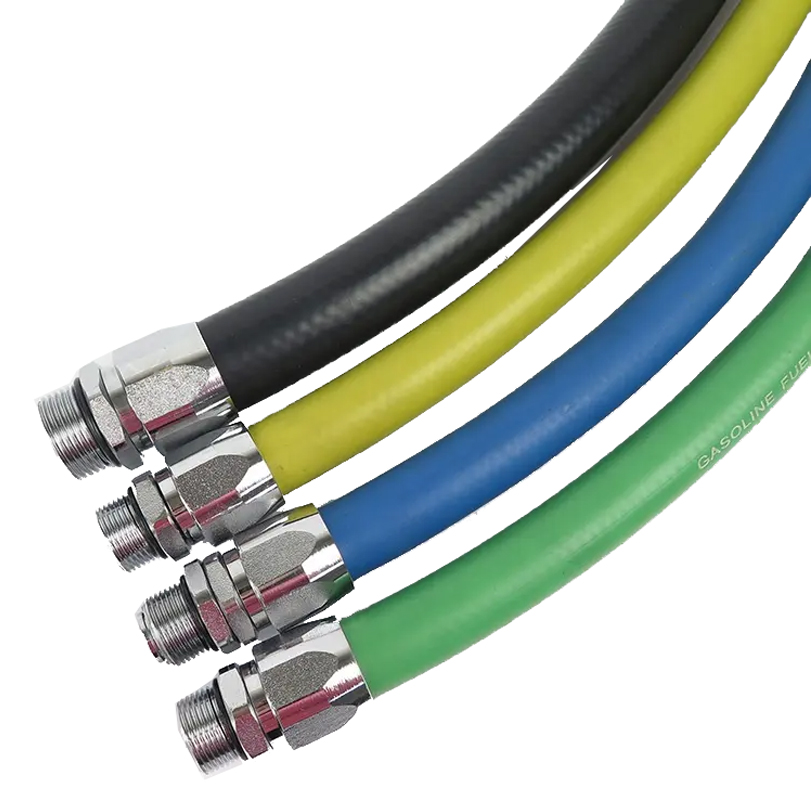
Performance & Engineering
PTFE hose performance is characterized by its broad operating temperature range (-200°C to +260°C), exceptional chemical inertness, low coefficient of friction, and excellent dielectric properties. Engineering considerations for PTFE hose design involve assessing internal pressure requirements, external load conditions, and fluid compatibility. Force analysis determines appropriate wall thickness and reinforcement type (braid count, material). For high-pressure applications, stainless steel 304 or 316L braiding is employed. Environmental resistance is a key factor; while PTFE is inherently UV resistant, prolonged exposure can lead to surface degradation. Furthermore, PTFE exhibits creep, a time-dependent deformation under sustained load. Engineers must account for creep when designing long-term fluid transfer systems, particularly at elevated temperatures. Compliance requirements vary by industry: FDA regulations dictate materials suitable for food and beverage applications, while USP Class VI compliance is essential for pharmaceutical environments. Electrical resistance is another crucial performance parameter, particularly in applications involving static discharge, where PTFE’s high resistivity is advantageous. Finally, burst pressure testing is a critical engineering verification step, ensuring the hose can withstand significantly beyond its operational pressure limits.
Technical Specifications
| Parameter | Standard PTFE Hose | Reinforced PTFE Hose (304SS Braid) | Convoluted PTFE Hose | PFA Lined PTFE Hose |
|---|---|---|---|---|
| Operating Pressure (PSI) | 500 | 2500 | 300 | 800 |
| Temperature Range (°C) | -200 to +260 | -200 to +260 | -200 to +260 | -200 to +200 |
| Tensile Strength (MPa) | 20 | 45 | 15 | 25 |
| Elongation at Break (%) | 300 | 150 | 200 | 250 |
| Chemical Resistance | Excellent (universal) | Excellent (universal) | Excellent (universal) | Excellent (universal) |
| Dielectric Strength (kV/mm) | 50 | 50 | 50 | 45 |
Failure Mode & Maintenance
PTFE hose, while robust, is susceptible to specific failure modes. Fatigue cracking can occur under cyclic pressure and bending, particularly at connection points. Delamination, though rare in properly sintered hose, can arise from inadequate processing or contamination during manufacturing. Chemical attack is unlikely due to PTFE’s inertness, but prolonged exposure to strong alkali metals or molten fluorine can cause degradation. Oxidation is not a significant concern under normal operating conditions. However, at extremely high temperatures (>260°C), PTFE can thermally degrade, releasing potentially harmful fumes. Creep, as previously mentioned, leads to dimensional changes and potential leaks over extended periods. Maintenance involves regular visual inspections for cracks, abrasions, or swelling. Connections should be tightened periodically. Avoid sharp bending radii, as this exacerbates fatigue cracking. Cleaning should be performed with mild detergents; avoid abrasive cleaners. If the hose is exposed to harsh chemicals, consult a chemical compatibility chart to confirm suitability. For heavily soiled hoses, ultrasonic cleaning is recommended. Replace the hose if any signs of significant damage or degradation are observed.
Industry FAQ
Q: What is the impact of PTFE resin molecular weight on hose performance?
A: Higher molecular weight PTFE resin generally results in improved creep resistance and mechanical strength. Longer polymer chains provide greater entanglement, hindering deformation under sustained load. However, higher molecular weight resins can be more challenging to process, requiring higher sintering temperatures and pressures.
Q: How does the braiding material affect the burst pressure of a reinforced PTFE hose?
A: The braiding material's tensile strength and weave pattern directly influence the burst pressure. Stainless steel 316L provides superior corrosion resistance and higher strength compared to 304SS, leading to a higher burst pressure capability. A tighter weave also increases the hose's ability to withstand internal pressure.
Q: What are the key considerations when selecting a PTFE hose for food and beverage applications?
A: FDA compliance (21 CFR 177.1550) is paramount. The hose must be free of leachable substances that could contaminate the food or beverage. Smooth internal surfaces are also crucial to prevent bacterial adhesion and facilitate cleaning. Furthermore, temperature resistance must align with the specific processing temperatures involved.
Q: How does PTFE hose compare to silicone hose in terms of chemical resistance?
A: PTFE offers significantly broader chemical resistance than silicone. Silicone is susceptible to attack by many solvents, oils, and fuels, while PTFE is virtually inert to most chemicals. However, silicone generally exhibits greater flexibility at lower temperatures.
Q: What is the typical lifespan of a PTFE hose under normal operating conditions?
A: The lifespan varies based on application, operating pressure, temperature, and fluid compatibility. With proper maintenance and within recommended operating parameters, a PTFE hose can last 5-10 years or longer. However, continuous exposure to extreme conditions will shorten its lifespan.
Conclusion
OEM production of PTFE hose demands meticulous attention to material selection, processing parameters, and quality control. PTFE’s unique combination of chemical resistance, thermal stability, and low friction makes it indispensable in diverse industrial applications. Understanding the nuanced relationships between material properties, manufacturing processes, and performance characteristics is critical for engineers and procurement professionals seeking optimized fluid transfer solutions. The increasing demand for specialized PTFE hose formulations will continue to drive innovation in manufacturing techniques and material science.
Furthermore, adherence to relevant industry standards and rigorous testing procedures are essential for ensuring product reliability and safety. Proactive failure mode analysis and implementation of preventative maintenance strategies are vital for maximizing the service life of PTFE hose systems. Choosing the right PTFE hose requires careful consideration of application-specific requirements, encompassing pressure, temperature, fluid compatibility, and regulatory compliance, ultimately ensuring optimal performance and minimizing downtime.