
Apr . 01, 2024 17:55 Back to list
oem production ptfe hose factories Performance Analysis

Introduction
Polytetrafluoroethylene (PTFE) hose represents a critical component in numerous industrial applications demanding exceptional chemical resistance, high-temperature performance, and non-stick properties. OEM production of PTFE hose involves specialized expertise in fluoropolymer processing, focusing on consistently delivering products that meet stringent industry specifications. This guide provides a comprehensive technical overview for procurement managers, engineers, and quality control personnel involved in sourcing PTFE hose, detailing material science, manufacturing processes, performance characteristics, failure modes, and relevant industry standards. The increasing demand for PTFE hose stems from its crucial role in demanding environments like chemical processing, automotive fuel systems, aerospace hydraulics, and pharmaceutical transfer, where other materials rapidly degrade. Selecting the correct PTFE hose construction – whether seamless, convoluted, or composite – directly impacts system reliability and longevity. OEM partners must demonstrate a deep understanding of these nuances to deliver fit-for-purpose solutions.
Material Science & Manufacturing
PTFE, commonly known as Teflon (DuPont’s trademark), is a synthetic fluoropolymer comprised of carbon and fluorine atoms. Its key properties are derived from the strong carbon-fluorine bonds, resulting in exceptional chemical inertness, a low coefficient of friction, and high thermal stability. Raw material selection is paramount; virgin PTFE resin provides superior performance compared to recycled or filled materials. Common PTFE resin grades include granular suspension polymerized PTFE and fine powder PTFE. Granular resins are typically used for extrusion, while fine powder resins are favored for molding and lining applications. Manufacturing processes for PTFE hose primarily include extrusion and lining. Extrusion involves forcing molten PTFE through a die to create a seamless tube. Critical parameters include melt temperature (typically 327-382°C), extrusion pressure, and die design. Post-extrusion sintering is crucial to consolidate the PTFE and develop its crystalline structure. Lining involves applying PTFE to a core material, often stainless steel or rubber, to provide a chemical barrier. This process requires meticulous surface preparation and bonding techniques. For convoluted hose, a specialized forming process is employed, often involving heated mandrels. Quality control during manufacturing emphasizes dimensional accuracy, wall thickness uniformity, and freedom from defects like voids and inclusions. Maintaining precise temperature control throughout the process is critical to prevent thermal degradation and maintain PTFE's desirable properties.
Performance & Engineering
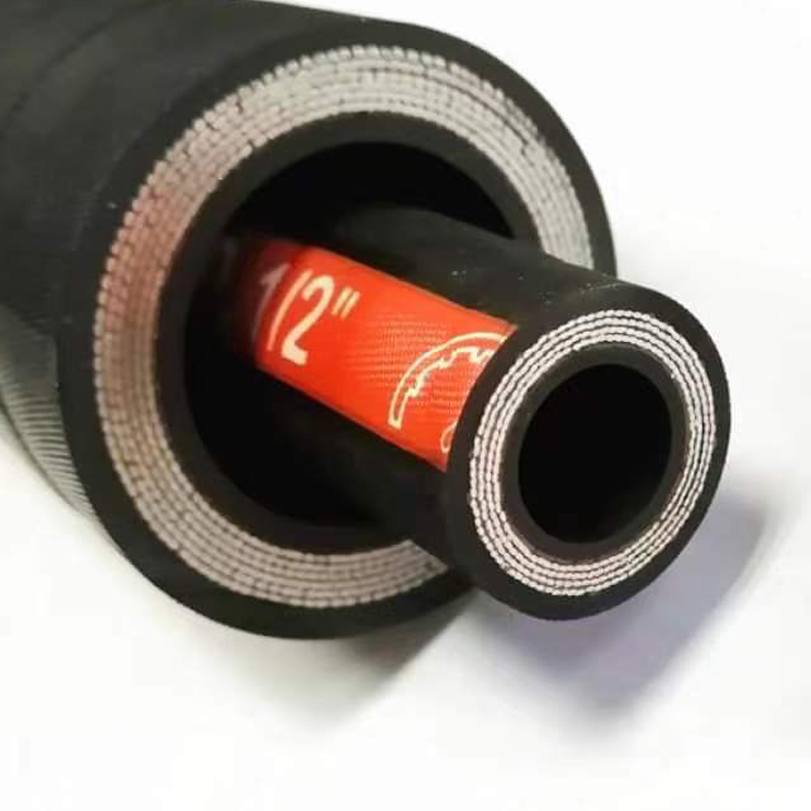
PTFE hose performance is dictated by several key engineering considerations. Pressure rating is a critical parameter, determined by hose dimensions, material grade, and operating temperature. Burst pressure testing, conforming to standards like ASTM D1418, is essential for verification. Temperature resistance is another key aspect; PTFE maintains its properties from -200°C to +260°C, although prolonged exposure to high temperatures can lead to gradual degradation. Chemical compatibility is where PTFE excels; it resists attack from virtually all chemicals, with the exception of molten alkali metals and some fluorinating agents. However, certain aggressive solvents can cause swelling. Hose flexibility is also important, particularly in applications requiring tight bends. Convoluted PTFE hose offers superior flexibility compared to smooth-bore tubing. In automotive fuel systems, PTFE hose must resist permeation of gasoline and ethanol. In hydraulic applications, it must withstand high pressures and resist abrasion. Force analysis during installation and operation is crucial; excessive bending or kinking can compromise hose integrity. Static electricity buildup is a potential concern, especially in flammable environments; conductive PTFE grades, incorporating carbon black, are used to dissipate static charges. Compliance with industry regulations, such as FDA 21 CFR 177.1550 for food and pharmaceutical applications, is paramount.
Technical Specifications
| Parameter | Unit | Standard PTFE | Conductive PTFE |
|---|---|---|---|
| Operating Temperature | °C | -200 to +260 | -200 to +260 |
| Tensile Strength | MPa | 20-35 | 18-32 |
| Elongation at Break | % | 100-300 | 80-250 |
| Burst Pressure (1" ID) | MPa | 3.5-7.0 | 3.0-6.5 |
| Chemical Resistance | Rating (1-5) | 5 (Excellent) | 5 (Excellent) |
| Surface Resistivity | Ω/cm | >1012 | <106 |
Failure Mode & Maintenance
PTFE hose, while remarkably durable, is susceptible to specific failure modes. Creep rupture, occurring under sustained pressure and elevated temperature, is a common concern. This involves slow, time-dependent deformation leading to eventual failure. Fatigue cracking can occur due to cyclic pressure fluctuations or repeated bending. Abrasion, particularly in applications involving abrasive media, can erode the PTFE lining. Chemical attack, although rare, can occur with specific aggressive chemicals. Permeation, especially in fuel systems, can lead to fuel loss and environmental contamination. For composite hoses, delamination between the PTFE liner and the reinforcement layer is a potential failure mode. Maintenance practices are critical to prolonging hose life. Regular visual inspection for cracks, abrasions, and swelling is essential. Pressure testing, at intervals determined by application criticality, should be performed. Proper installation, avoiding excessive bending and kinking, is crucial. Avoid exposure to incompatible chemicals. When cleaning, use mild detergents and avoid abrasive cleaners. For conductive PTFE hose, ensure the continuity of the conductive path is maintained. Promptly replace any hose exhibiting signs of damage or degradation. Detailed failure analysis, including microscopic examination of fractured surfaces, can identify the root cause of failures and inform future design improvements.
Industry FAQ
Q: What is the difference between virgin PTFE and filled PTFE, and when would I choose one over the other?
A: Virgin PTFE offers the highest purity and widest chemical compatibility. It's preferred for critical applications demanding maximum resistance to corrosion and contamination. Filled PTFE incorporates additives like glass fibers, carbon, or bronze to enhance mechanical properties like creep resistance and stiffness. Filled PTFE is often chosen for higher-pressure applications or when improved dimensional stability is required, but it may compromise chemical resistance slightly.
Q: How does the operating temperature affect the service life of PTFE hose?
A: While PTFE is stable across a wide temperature range, prolonged exposure to temperatures near its upper limit (+260°C) can lead to gradual degradation and embrittlement. Lower temperatures generally extend service life. It’s crucial to verify the hose’s temperature rating for the specific application and avoid exceeding it. Thermal cycling can also contribute to fatigue and reduce lifespan.
Q: What testing is typically performed to ensure the quality and reliability of PTFE hose?
A: Standard tests include hydrostatic pressure testing (ASTM D1418), tensile strength testing (ASTM D4895), elongation testing, burst pressure testing, and chemical resistance testing. For conductive PTFE, surface resistivity testing (ASTM D257) is also performed. Permeation testing is crucial for fuel system applications. Dimensional accuracy and wall thickness are also verified during quality control.
Q: Can PTFE hose be used with vacuum applications?
A: Yes, PTFE is well-suited for vacuum applications due to its low permeability and resistance to outgassing. However, the hose must be adequately supported to prevent collapse under vacuum pressure. Reinforced PTFE hose is often preferred for vacuum service.
Q: What are the key considerations when selecting a fitting for PTFE hose?
A: Fittings must be chemically compatible with the PTFE hose and the conveyed fluid. Stainless steel fittings are commonly used. Proper crimping or swaging techniques are essential to ensure a leak-tight seal. The fitting’s pressure rating must match or exceed the hose’s rating. Avoid using fittings that can damage or distort the PTFE hose during installation.
Conclusion
OEM production of PTFE hose necessitates a thorough understanding of material science, manufacturing techniques, and performance characteristics. The inherent chemical resistance and thermal stability of PTFE make it an indispensable material in numerous critical applications. However, optimizing hose performance requires careful consideration of factors such as pressure rating, temperature, and chemical compatibility, alongside meticulous quality control throughout the manufacturing process.
Looking ahead, advancements in PTFE technology are focused on developing enhanced formulations with improved creep resistance, higher temperature capabilities, and reduced permeation rates. Sustainable manufacturing practices, including minimizing waste and utilizing recycled PTFE materials, are also gaining prominence. Selecting a qualified OEM partner with a proven track record and a commitment to continuous improvement is vital for securing reliable and high-performance PTFE hose solutions.