
Apr . 01, 2024 17:55 Back to list
oem one wire braided hydraulic hose suppliers Performance Analysis
Introduction
OEM one wire braided hydraulic hose suppliers represent a critical component within the broader fluid power industry. These hoses are engineered to transmit hydraulic fluid under high pressure, serving as the vital arteries of machinery across diverse sectors including construction, agriculture, mining, manufacturing, and aerospace. Unlike two-wire or four-wire braided hoses, the single-wire braid configuration provides a balance between flexibility and pressure capacity, making them suitable for applications where tighter bend radii are required without compromising structural integrity. The ‘OEM’ designation signifies that these hoses are frequently manufactured to the specific requirements of Original Equipment Manufacturers, adhering to precise dimensional tolerances, material specifications, and performance characteristics dictated by the end-use equipment design. This guide will delve into the materials, manufacturing processes, performance parameters, potential failure modes, and relevant industry standards associated with these specialized hydraulic hoses, focusing on the technical challenges and solutions pertinent to B2B procurement and engineering teams.
Material Science & Manufacturing
The core construction of a one wire braided hydraulic hose involves four primary material components: the inner tube, the reinforcement braid, the outer cover, and potentially, intermediate layers for enhanced performance. The inner tube is typically composed of synthetic rubbers designed for compatibility with the hydraulic fluid being conveyed. Common materials include nitrile rubber (NBR) for petroleum-based fluids, ethylene propylene diene monomer (EPDM) for phosphate ester fluids, and fluorocarbon elastomers (FKM/Viton) for aggressive chemicals and high-temperature applications. Material selection is driven by fluid compatibility, temperature range, and pressure requirements. The reinforcement braid is almost exclusively high-tensile steel wire, conforming to standards like SAE J517. The number of wires in the braid directly influences the hose’s burst pressure and flexibility. One-wire braids offer a compromise. The outer cover, providing abrasion and environmental protection, is typically a blend of synthetic rubbers like chloroprene (Neoprene) or polyurethane. Manufacturing processes begin with extrusion of the inner tube, followed by the precise winding of the steel wire braid using automated braiding machines. Key process parameters include braid angle, tension control, and wire overlap, all directly impacting hose strength and flexibility. After braiding, the outer cover is extruded, and the hose undergoes curing (vulcanization) to achieve final material properties. Quality control involves rigorous testing of dimensional accuracy, burst pressure, impulse pressure, and fluid compatibility throughout the process. Dimensional control is maintained using laser gauging and automated inspection systems.
Performance & Engineering
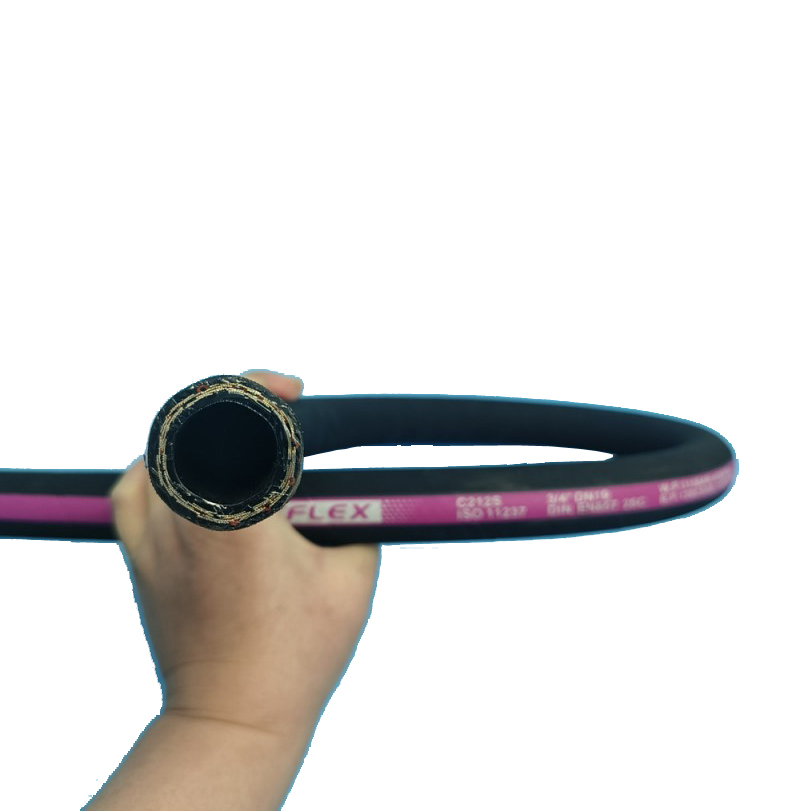
The performance of a one wire braided hydraulic hose is dictated by its ability to withstand internal pressure, external damage, and dynamic flexing. Burst pressure, determined through hydrostatic testing (typically to 3:1 safety factor), is a fundamental parameter. Impulse pressure, accounting for pressure pulsations and transient spikes common in hydraulic systems, is equally critical. This is assessed through repetitive cyclic pressure testing. Hose flexibility, measured by bend radius, is crucial for installation in confined spaces. A tighter bend radius requires a more flexible hose, often achieved through optimized braid geometry and cover compound selection. Finite Element Analysis (FEA) is frequently employed during the design phase to model stress distribution within the hose under various loading conditions, optimizing braid configuration and material properties. Environmental resistance, including ozone, UV exposure, and chemical attack, is addressed through appropriate cover material selection. Compliance requirements, such as those outlined by SAE, EN, and DIN standards, dictate minimum performance criteria and testing procedures. Furthermore, the hose’s fitting compatibility and crimping procedures are essential engineering considerations. Improper crimping can lead to premature failure at the fitting interface. Force analysis considers hoop stress within the tube, tensile stress within the braid, and shear stress at the interfaces between layers. Static and dynamic fatigue analysis are key to predicting long-term hose durability.
Technical Specifications
| Parameter | Unit | Typical Value (SAE 100R1AT Equivalent) | Test Standard |
|---|---|---|---|
| Working Pressure | PSI | 1000 | SAE J517 |
| Burst Pressure | PSI | 3000 | SAE J517 |
| Inner Tube Material | - | NBR (Nitrile Rubber) | ASTM D2000 |
| Reinforcement Braid | - | Single Layer Steel Wire | SAE J517 |
| Outer Cover Material | - | Chloroprene (Neoprene) | ASTM D2000 |
| Temperature Range | °F | -40 to +212 | SAE J517 |
Failure Mode & Maintenance
One wire braided hydraulic hoses are susceptible to several failure modes. Fatigue cracking, induced by repeated flexing and pressure cycling, is a common issue, often initiating at the braid-tube interface. Corrosion, particularly in environments with moisture and chlorides, can weaken the steel braid, leading to rupture. Abrasion damage to the outer cover exposes the braid to corrosion and can compromise the hose’s structural integrity. Improper installation, including excessive bending or twisting, can create stress concentrations and accelerate failure. Internal tube degradation, caused by fluid incompatibility or high temperatures, results in swelling, softening, and eventual cracking. Fitting failures, often stemming from inadequate crimping, can lead to leakage or complete separation. Preventive maintenance includes regular visual inspections for abrasion, cracking, and leaks. Monitoring fluid condition and ensuring compatibility with hose materials is crucial. Hose routing should minimize bending and twisting. Crimping procedures must adhere to manufacturer’s specifications. If corrosion is detected, the hose should be replaced immediately. A detailed failure analysis, including metallurgical examination of the braid and chemical analysis of the tube material, can identify the root cause of failures and inform preventative measures.
Industry FAQ
Q: What is the primary advantage of a one-wire braided hose over a two-wire or four-wire design in specific applications?
A: The primary advantage lies in its increased flexibility. While two and four-wire braids offer higher burst pressures, the one-wire construction allows for tighter bend radii, making it ideal for applications with limited space or complex routing requirements. The reduced weight can also be a benefit in certain mobile applications.
Q: How does temperature affect the performance and lifespan of a nitrile rubber (NBR) inner tube?
A: NBR’s performance degrades at both high and low temperatures. Elevated temperatures can cause swelling and softening, reducing pressure capacity and increasing the risk of failure. Low temperatures can lead to embrittlement and reduced flexibility. Operating outside the recommended temperature range significantly reduces lifespan.
Q: What are the critical considerations when selecting a fitting for a one-wire braided hose?
A: Fitting compatibility, crimp specifications, and material corrosion resistance are critical. The fitting must be specifically designed for use with one-wire braided hose. The crimp must be performed according to the hose and fitting manufacturer’s recommendations to ensure a secure and leak-proof connection. The fitting material should be compatible with the hydraulic fluid and operating environment.
Q: What impact does hydraulic fluid contamination have on hose life?
A: Fluid contamination, including particulate matter, water, and chemical degradation products, significantly reduces hose life. Abrasive particles can erode the inner tube, leading to leakage and failure. Water can promote corrosion of the steel braid. Degradation products can alter the rubber’s properties, reducing its elasticity and strength.
Q: What testing is typically performed to ensure the quality and reliability of OEM one wire braided hydraulic hoses?
A: Typical testing includes hydrostatic testing (burst pressure), impulse testing (cyclic pressure), dimensional inspection, tensile strength testing of the braid, and fluid compatibility testing of the inner tube. Some manufacturers also perform accelerated aging tests and bend fatigue tests to simulate long-term use.
Conclusion
OEM one wire braided hydraulic hoses play a crucial role in various industrial applications, demanding a comprehensive understanding of material science, manufacturing processes, and performance characteristics. The balance between flexibility and pressure capability offered by this hose type makes it a practical solution for numerous fluid power systems. Rigorous quality control, adherence to industry standards, and proactive maintenance are paramount to ensuring long-term reliability and preventing catastrophic failures.
Future developments in this area may focus on advanced materials – such as thermoplastic composites for lighter weight and increased corrosion resistance – and improved braiding techniques to enhance performance. Optimizing hose design through advanced modeling and simulation will further enhance durability and extend service life. Continuing to refine manufacturing processes and quality control protocols will remain essential to meeting the evolving demands of the OEM market.