
Apr . 01, 2024 17:55 Back to list
oem hydraulic industrial hose manufacturer Performance Analysis
Introduction
OEM hydraulic industrial hose constitutes a critical component within fluid power systems across diverse sectors including construction, agriculture, manufacturing, and oil & gas. These hoses are engineered to reliably transmit hydraulic fluid under high pressure, facilitating the operation of hydraulic machinery. Unlike commodity hoses, OEM offerings are typically designed and manufactured to precise customer specifications, integrating seamlessly into complex equipment architectures. The key performance characteristics are burst pressure, working pressure, temperature resistance, fluid compatibility, and dimensional accuracy. A significant pain point in the industry revolves around achieving consistent quality, particularly in meeting stringent safety requirements and preventing catastrophic failures. Furthermore, the need for specialized hose assemblies tailored to increasingly sophisticated hydraulic systems demands advanced manufacturing capabilities and materials expertise. The competitive landscape is characterized by a shift towards lighter-weight, high-performance hoses capable of withstanding extreme operating conditions and extended service life. Understanding the interplay between hose construction, material selection, and operational parameters is paramount for ensuring system integrity and minimizing downtime.
Material Science & Manufacturing
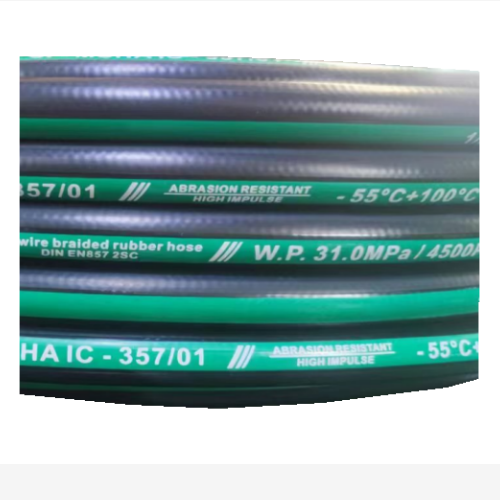
Hydraulic hoses are constructed from multiple layers, each contributing to specific performance characteristics. The inner tube, typically composed of synthetic rubbers like nitrile (NBR), ethylene propylene diene monomer (EPDM), or fluorocarbon (FKM – Viton), provides fluid resistance. NBR excels with petroleum-based fluids, EPDM handles phosphate ester fluids, and FKM delivers superior resistance to aggressive chemicals and high temperatures. Reinforcement layers, critical for pressure containment, utilize high-tensile steel wire (single or multi-spiral), aramid fiber (Kevlar), or textile braids. Steel wire provides the highest pressure capacity, while aramid offers a lighter-weight alternative with good strength. The outer cover, commonly made from chloroprene (CR) or polyurethane (PU), protects against abrasion, ozone, UV radiation, and environmental degradation.
Manufacturing processes vary based on hose type and complexity. For rubber hoses, a key process is extrusion, where the rubber compound is forced through a die to create the inner tube and outer cover. Reinforcement layers are then applied via winding or braiding. A curing process, involving heat and pressure, vulcanizes the rubber, creating a durable and flexible structure. Thermoplastic hoses are manufactured using injection molding or extrusion techniques, often employing co-extrusion to create multi-layered constructions. Quality control is vital throughout the manufacturing process, including raw material inspection, dimensional checks, pressure testing (to specified burst pressure requirements, often exceeding working pressure by a 3:1 or 4:1 safety factor), and leak testing. Precise control of temperature, pressure, and curing time during vulcanization is essential for achieving consistent mechanical properties and preventing defects like porosity or incomplete curing. Furthermore, adherence to rigorous material traceability protocols is crucial for ensuring accountability and facilitating failure analysis.

Performance & Engineering
The performance of a hydraulic hose is governed by fundamental engineering principles, including stress-strain relationships, fluid dynamics, and thermal expansion. Hose selection must consider operating pressure, flow rate, fluid type, and temperature range. Finite element analysis (FEA) is routinely employed to simulate hose behavior under various loading conditions, predicting stress distribution and identifying potential failure points. Burst pressure, the maximum pressure a hose can withstand before rupture, is a critical design parameter. Working pressure is typically a fraction of the burst pressure, providing a safety margin. Hose assemblies also experience bending and flexing, inducing fatigue stresses. The fatigue life is dependent on the amplitude and frequency of bending, as well as the hose’s material properties and construction. Compliance requirements, such as those outlined by SAE (Society of Automotive Engineers) standards, dictate hose performance specifications and testing procedures. Proper hose routing and support are essential to prevent kinking, abrasion, and excessive bending, which can significantly reduce hose life. Consideration must also be given to fluid compatibility; incompatible fluids can cause swelling, degradation, or leaching of hose materials, leading to premature failure.
Technical Specifications
| Parameter | Unit | SAE 100R1 AT | SAE 100R2 AT |
|---|---|---|---|
| Working Pressure | MPa | 20.7 | 34.5 |
| Burst Pressure | MPa | 82.7 | 138.0 |
| Temperature Range | °C | -40 to +100 | -40 to +121 |
| Inner Tube | Material | NBR | NBR |
| Reinforcement | Material | Single Steel Wire Braid | Double Steel Wire Braid |
| Outer Cover | Material | CR | CR |
Failure Mode & Maintenance
Hydraulic hose failures can stem from a variety of factors. Fatigue cracking, induced by repeated bending and flexing, is a common mode, particularly in high-cycle applications. Pinholes and cracks can also develop due to abrasion from rubbing against adjacent components. Internal degradation, caused by fluid incompatibility or contamination, leads to softening and weakening of the hose material. External damage, such as cuts or punctures, can result in sudden fluid leaks and catastrophic failure. Swelling of the inner tube, due to fluid absorption, can cause the hose to burst. Coupling failures, including thread stripping or seal leakage, contribute significantly to downtime.
Preventative maintenance is crucial for maximizing hose life and preventing failures. Regular visual inspections should be conducted to identify signs of abrasion, cracking, or swelling. Hose assemblies should be properly supported to prevent kinking and excessive bending. Fluid contamination should be minimized through filtration and regular fluid changes. Couplings should be tightened to the correct torque specification. If a hose shows signs of damage, it should be replaced immediately. Proper hose storage, away from direct sunlight, ozone sources, and extreme temperatures, can extend its service life. Maintaining detailed records of hose replacements and failure analysis can help identify recurring problems and improve system reliability. Consider implementing a hose management program to track hose lifecycles and schedule preventative maintenance tasks.
Industry FAQ
Q: What is the significance of SAE standards in hydraulic hose selection?
A: SAE standards (e.g., SAE 100R1, SAE 100R2, SAE J518) provide a standardized framework for defining hose performance characteristics, including working pressure, burst pressure, temperature range, and fluid compatibility. Adherence to these standards ensures interchangeability, safety, and reliability. Selecting hoses that meet or exceed the relevant SAE specifications is crucial for ensuring system integrity and preventing failures.
Q: How does temperature affect hydraulic hose performance?
A: Temperature extremes can significantly impact hose performance. High temperatures accelerate material degradation and reduce the hose’s tensile strength. Low temperatures can cause the rubber to become brittle and less flexible. The specified temperature range for a hose must be carefully considered based on the operating environment. Using a hose outside its designated temperature range can lead to premature failure.
Q: What is the role of the reinforcement layer in a hydraulic hose?
A: The reinforcement layer provides the primary structural support for the hose, resisting internal pressure and preventing bursting. The type of reinforcement material (steel wire, aramid fiber, textile braid) determines the hose’s pressure capacity and flexibility. Steel wire offers the highest pressure rating, while aramid provides a lighter-weight solution with good strength.
Q: How important is fluid compatibility when selecting a hydraulic hose?
A: Fluid compatibility is paramount. Using an incompatible fluid can cause the inner tube to swell, soften, or degrade, leading to leaks and failure. The hose’s inner tube material must be specifically chosen to be compatible with the hydraulic fluid being used. Refer to fluid compatibility charts provided by hose manufacturers.
Q: What are best practices for hose assembly and installation?
A: Proper hose assembly and installation are critical. Ensure couplings are correctly sized and torqued to the manufacturer’s specifications. Avoid sharp bends and kinks during installation. Provide adequate support to prevent abrasion and flexing fatigue. Use hose guards to protect against external damage. Pressure test the assembly after installation to verify leak-free operation.
Conclusion
OEM hydraulic industrial hoses represent a critical link in the reliable operation of fluid power systems. Their design and manufacturing are predicated on a complex interplay of material science, engineering principles, and adherence to stringent industry standards. Selection criteria extend beyond basic pressure and temperature ratings, necessitating careful consideration of fluid compatibility, environmental factors, and potential failure modes. By prioritizing robust materials, precise manufacturing processes, and comprehensive preventative maintenance programs, operators can maximize hose life, minimize downtime, and ensure the safe and efficient operation of their hydraulic equipment.
Future trends in hydraulic hose technology focus on the development of lighter-weight materials, improved abrasion resistance, and enhanced fluid compatibility. Smart hoses, incorporating sensors to monitor pressure, temperature, and flow, are emerging as a means of providing real-time performance data and predictive maintenance capabilities. As hydraulic systems become increasingly sophisticated, the demand for customized hose solutions tailored to specific application requirements will continue to grow, driving innovation in materials and manufacturing techniques.