
Apr . 01, 2024 17:55 Back to list
oem en 857 2sc hydraulic hose factory Performance Analysis
Introduction
The EN 857 2SC hydraulic hose represents a critical component in fluid power systems across diverse industries, including construction, agriculture, mining, and manufacturing. This hose standard, defined by the European Norm 857, specifically designates a two-steel-wire spiral reinforced construction (2SC) designed for high-pressure hydraulic applications. OEM (Original Equipment Manufacturer) production of these hoses focuses on consistent adherence to this standard, offering reliable fluid conveyance under demanding conditions. Its technical position in the industry chain lies between the raw material suppliers (synthetic rubber, steel wire) and the end-users integrating these hoses into complex hydraulic machinery. Core performance characteristics include high pressure capability, excellent flexibility, and resistance to hydraulic fluids, ensuring safe and efficient power transmission. The 2SC construction distinguishes itself from other reinforcement types (e.g., 1SC, 4SP) by its superior pressure ratings and flexibility, making it suitable for dynamic applications with demanding bend radii. The increasing demands for higher operating pressures in modern hydraulic systems, coupled with a need for extended hose service life, drive continuous improvement in materials and manufacturing processes within the OEM landscape.
Material Science & Manufacturing
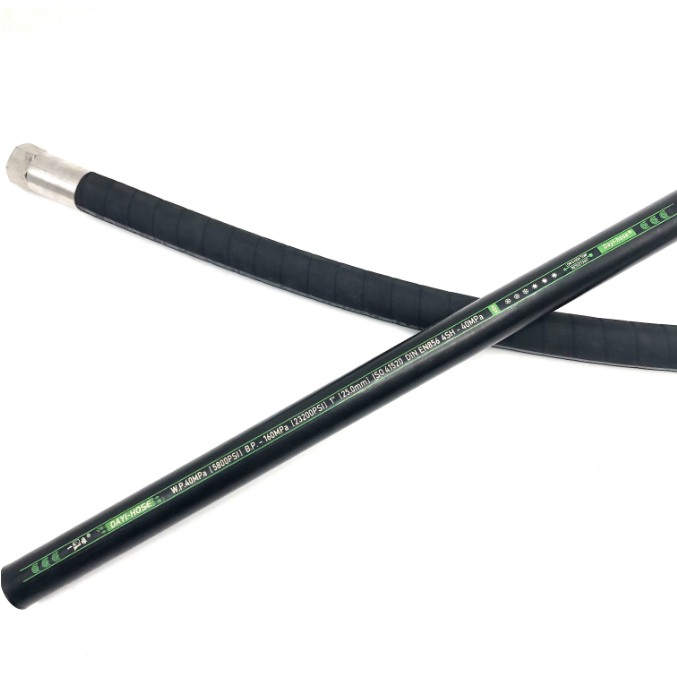
The EN 857 2SC hydraulic hose construction relies on a precise combination of materials and manufacturing techniques. The inner tube is typically comprised of a synthetic rubber compound, most commonly nitrile rubber (NBR) due to its excellent resistance to petroleum-based hydraulic fluids. Alternative materials, such as chloroprene rubber (CR) may be used for specialized applications requiring enhanced temperature or chemical resistance. NBR's chemical structure, based on acrylonitrile and butadiene, provides inherent sealing properties and resistance to degradation. The reinforcement layer consists of two layers of high-tensile steel wire spirally wound around the inner tube. The steel wire is crucial for withstanding the high internal pressures. Wire diameter, tensile strength, and surface treatment (e.g., zinc coating for corrosion protection) are precisely controlled parameters. The outer cover is generally made of a synthetic rubber blend, frequently incorporating ethylene propylene diene monomer (EPDM) for excellent weather resistance, ozone resistance, and abrasion resistance. Manufacturing involves a multi-stage process. First, the inner tube is extruded through a die, establishing the desired internal diameter and wall thickness. The steel wire is then spirally wound onto the tube, maintained under tension to ensure consistent pitch and coverage. Finally, the outer cover is extruded, encapsulating the reinforcement layer. Curing, a critical step, involves vulcanization of the rubber compounds using heat and pressure, creating a cross-linked polymer matrix that imparts elasticity, strength, and durability. Key parameter control includes rubber compound viscosity, extrusion temperature, winding tension, and curing time/temperature profiles. Dimensional accuracy is vital, and is verified using calibrated measuring equipment.
Performance & Engineering
The performance of an EN 857 2SC hydraulic hose is governed by several engineering principles. Pressure rating is a primary concern, dictated by the reinforcement layer’s strength and the rubber compound’s ability to maintain integrity under stress. Burst pressure is typically four times the working pressure, providing a substantial safety factor. Force analysis considers hoop stress within the hose wall, which increases linearly with internal pressure and hose diameter. Fatigue life is critical, as hydraulic systems are often subjected to cyclical loading. Fatigue failure can occur due to repeated flexing, pressure pulsations, and exposure to environmental factors. Environmental resistance encompasses temperature variations, UV exposure, ozone exposure, and chemical compatibility with the hydraulic fluid. The hose must maintain its flexibility and structural integrity across a specified temperature range. Compliance requirements are paramount. EN 857 specifies rigorous testing procedures for pressure resistance, impulse testing, temperature resistance, and dimensional accuracy. Furthermore, hoses intended for specific applications may need to comply with additional industry-specific standards (e.g., SAE J517 for North American markets). Functional implementation requires careful consideration of bend radius. Exceeding the minimum bend radius can induce excessive stress in the reinforcement layer, leading to premature failure. Proper hose assembly, including the selection of compatible fittings and correct crimping procedures, is also crucial for ensuring reliable performance. Hydraulic fluid compatibility is essential. Incompatibility can cause swelling, softening, or degradation of the rubber compounds, compromising the hose's integrity.
Technical Specifications
| Parameter | Unit | Typical Value (EN 857 2SC) | Testing Standard |
|---|---|---|---|
| Working Pressure | MPa | 25 - 35 | EN 857 |
| Burst Pressure | MPa | 100 - 140 | EN 857 |
| Temperature Range | °C | -40 to +100 | EN 857 |
| Minimum Bend Radius | mm | 4 - 6 x Outer Diameter | EN 857 |
| Inner Tube Material | - | NBR (Nitrile Rubber) | EN 857 |
| Reinforcement | - | 2 Steel Wire Spiral | EN 857 |
Failure Mode & Maintenance
EN 857 2SC hydraulic hoses are susceptible to several failure modes. Fatigue cracking, a common issue, arises from repeated flexing and pressure pulsations, initiating at stress concentration points (e.g., fitting interfaces). Delamination, the separation of rubber layers from the reinforcement, can occur due to inadequate bonding or exposure to incompatible fluids. Degradation of the rubber compounds, caused by exposure to ozone, UV radiation, or extreme temperatures, leads to loss of elasticity and increased susceptibility to cracking. Oxidation, particularly in the presence of high temperatures and oxygen, can cause hardening and embrittlement. Pinholes, small punctures in the inner tube, can result from abrasion or corrosion. External damage, such as cuts or abrasions, can compromise the hose's integrity. Maintenance involves regular visual inspections for signs of wear, damage, or fluid leakage. Hose assemblies should be replaced proactively based on a predetermined service life or after any observed damage. Proper storage is crucial. Hoses should be stored in a cool, dry, and dark environment, away from ozone sources and direct sunlight. Avoid kinking or twisting the hose during storage or operation. Regularly check fitting connections for tightness and corrosion. When replacing a hose, ensure the new hose has the same or higher pressure rating and is compatible with the hydraulic fluid. Implement a hose management program to track hose age, usage, and maintenance history.
Industry FAQ
Q: What is the significance of the "2SC" designation in EN 857 2SC hoses?
A: The "2SC" designation signifies that the hose utilizes two layers of steel wire spirally wound for reinforcement. This construction provides a higher pressure rating and improved flexibility compared to hoses with a single wire layer (1SC) or braided reinforcement (4SP). It is optimal for applications requiring high flow rates and demanding bend radii.
Q: How does temperature affect the performance of an EN 857 2SC hose?
A: Extreme temperatures, both high and low, can significantly impact hose performance. High temperatures accelerate rubber degradation and reduce pressure ratings. Low temperatures can reduce flexibility and increase the risk of cracking. The EN 857 standard defines a specified temperature range (-40°C to +100°C) within which the hose is expected to perform reliably. Operating outside this range should be avoided.
Q: What type of hydraulic fluid is compatible with a standard NBR inner tube?
A: NBR inner tubes are generally compatible with petroleum-based hydraulic fluids, including mineral oils and synthetic hydrocarbon fluids. However, they are not suitable for phosphate ester fluids, which can cause swelling and degradation. It’s essential to verify fluid compatibility before use to prevent premature hose failure.
Q: What are the potential consequences of exceeding the minimum bend radius?
A: Exceeding the minimum bend radius introduces excessive stress in the reinforcement layer, particularly at the bend point. This can lead to fatigue cracking, delamination, or even immediate failure. Always adhere to the manufacturer's recommended minimum bend radius to ensure long-term hose reliability.
Q: How often should EN 857 2SC hydraulic hoses be replaced?
A: The replacement frequency depends on operating conditions, fluid type, and usage intensity. A general guideline is to replace hoses every 5-7 years, regardless of visual condition. However, more frequent inspections and replacement may be necessary in harsh environments or critical applications. Regular inspections for cracks, bulges, or leaks are essential.
Conclusion
The EN 857 2SC hydraulic hose remains a cornerstone of fluid power transmission, offering a robust and reliable solution for demanding applications. Its performance is fundamentally linked to the careful selection of materials – from the nitrile rubber inner tube to the high-tensile steel wire reinforcement and the weather-resistant outer cover – and a rigorously controlled manufacturing process ensuring dimensional accuracy and structural integrity. Understanding the potential failure modes, including fatigue cracking, degradation, and delamination, coupled with diligent maintenance practices, is paramount to maximizing hose service life and preventing costly downtime.
Future developments in hydraulic hose technology will likely focus on enhancing material properties to withstand even higher pressures and temperatures, improving resistance to aggressive fluids, and integrating sensor technologies for real-time condition monitoring. The continued adherence to, and refinement of, standards such as EN 857 will be crucial in driving innovation and ensuring the safety and efficiency of hydraulic systems across diverse industries. OEM manufacturers are expected to play a pivotal role in this evolution, providing cutting-edge solutions that meet the ever-increasing demands of modern hydraulic applications.