
Apr . 01, 2024 17:55 Back to list
oem convoluted ptfe hose supplier Performance Analysis
Introduction
Convoluted PTFE hose represents a critical component in fluid transfer systems across diverse industries, including chemical processing, pharmaceutical manufacturing, automotive, and aerospace. These hoses are engineered to provide a flexible, chemically inert pathway for the transport of aggressive fluids and gases. Unlike traditional smooth-bore PTFE tubing, the convoluted design imparts enhanced flexibility, enabling routing around obstacles and minimizing stress concentrations in dynamic applications. OEM convoluted PTFE hose suppliers play a vital role in providing customized solutions tailored to specific application requirements, often incorporating specific fittings, lengths, and pressure ratings. Core performance characteristics include broad chemical compatibility, high-temperature resistance (typically -200°C to +260°C), low permeability, and excellent dielectric properties. The increasing demand for reliable fluid handling in harsh environments drives the need for high-quality, customized convoluted PTFE hose solutions. A key pain point within the industry lies in consistently maintaining dimensional accuracy during convolution and ensuring the integrity of the PTFE material throughout the manufacturing process, leading to potential failure points if not adequately addressed.
Material Science & Manufacturing
The primary raw material for convoluted PTFE hose is polytetrafluoroethylene (PTFE) resin, a synthetic fluoropolymer renowned for its exceptional chemical inertness, high thermal stability, and low coefficient of friction. Common PTFE resin types used include granular suspension polymerized PTFE and fine powder PTFE, each offering distinct processing characteristics. Granular PTFE exhibits improved creep resistance, while fine powder PTFE is preferred for sintering into complex shapes. The manufacturing process typically involves several stages. First, the PTFE resin is pre-formed into a tube through extrusion or ram extrusion. This tube then undergoes a convolution process, employing specialized tooling and precise control of parameters like temperature, pressure, and feed rate to create the desired helical structure. Critical parameters include the convolution pitch (distance between peaks), the convolution height (depth of the corrugation), and the overall hose diameter. Following convolution, the hose is sintered – a process involving heating the PTFE tube to a temperature below its melting point, causing the polymer particles to fuse together, achieving density and structural integrity. Sintering parameters, including temperature ramp rates, soak times, and atmospheric control (often utilizing inert gases), significantly influence the final material properties. Quality control at each stage is paramount, including dimensional inspection, visual defect analysis, and leak testing. Chemical compatibility is ensured through material certification and, in some cases, immersion testing with representative fluids. The metal fittings used, typically stainless steel or alloy materials, must exhibit comparable corrosion resistance to the PTFE to prevent galvanic corrosion and maintain long-term system integrity.
Performance & Engineering
The performance of convoluted PTFE hose is dictated by its ability to withstand the combined effects of pressure, temperature, chemical exposure, and mechanical stress. Force analysis is crucial, particularly regarding burst pressure, which is determined by the PTFE wall thickness, convolution geometry, and fitting integrity. Burst pressure testing is conducted in accordance with industry standards (see footer). Flexural fatigue resistance is also a critical consideration, especially in dynamic applications involving repeated bending or vibration. The convolution design minimizes stress concentration compared to sharp bends in smooth-bore tubing, extending the hose’s service life. Environmental resistance encompasses a broad spectrum of factors, including exposure to ultraviolet (UV) radiation, ozone, and weathering. While PTFE is inherently UV resistant, prolonged exposure can lead to surface degradation. Compliance requirements vary depending on the target industry. For example, pharmaceutical applications necessitate compliance with USP Class VI standards for biocompatibility and extractables/leachables testing. Food and beverage applications require compliance with FDA regulations. Aerospace applications often demand adherence to AMS specifications. Functional implementation involves careful selection of hose size, convolution pitch, and fitting materials to optimize flow rate, minimize pressure drop, and ensure a secure, leak-proof connection. Furthermore, proper installation practices, including avoiding excessive bending radius and ensuring adequate support, are essential for maximizing performance and preventing premature failure.
Technical Specifications
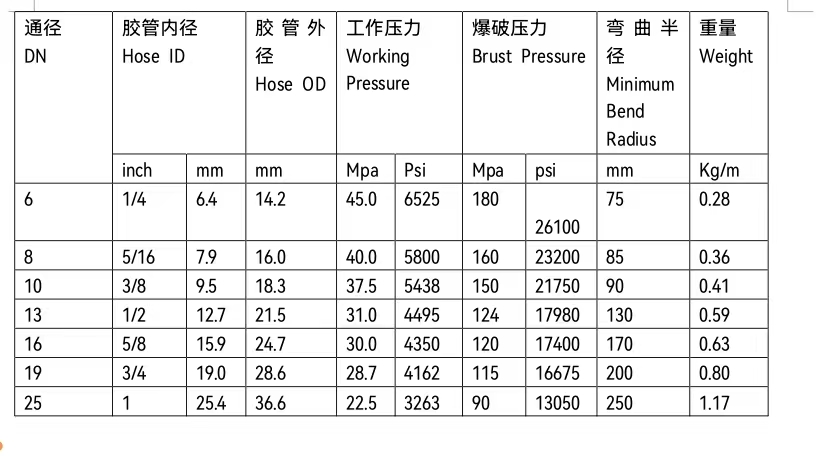
| Parameter | Unit | Typical Value | Testing Standard |
|---|---|---|---|
| Working Pressure | psi | Up to 500 | ASTM D1418 |
| Burst Pressure | psi | 1500 - 2000 | ASTM D1418 |
| Temperature Range | °C | -200 to +260 | ASTM D3418 |
| Chemical Resistance | - | Excellent to most chemicals | ASTM F1554 |
| Tensile Strength | MPa | 20 - 30 | ASTM D638 |
| Elongation at Break | % | 150 - 300 | ASTM D638 |
Failure Mode & Maintenance
Convoluted PTFE hose, while robust, is susceptible to several failure modes. Fatigue cracking can occur in areas of high stress concentration, particularly at the convolution roots, resulting from repeated flexing or vibration. Delamination, the separation of PTFE layers, can arise from inadequate sintering or contamination during manufacturing. Chemical attack, though rare given PTFE's inertness, can occur with highly aggressive chemicals or at elevated temperatures. Permeation, the diffusion of gases or liquids through the PTFE wall, can be a concern in applications requiring strict containment. Oxidation can occur at extremely high temperatures, leading to material degradation. Proper maintenance is critical for extending service life. Regular visual inspection should be conducted to identify signs of cracking, swelling, discoloration, or delamination. Avoid exceeding the specified working pressure and temperature limits. Protect the hose from physical damage, such as abrasion or impact. Implement a preventative maintenance schedule that includes periodic leak testing and replacement of hoses based on their service history and operating conditions. In the event of a leak or other failure, the hose should be immediately removed from service and replaced. Thorough cleaning with compatible solvents can extend service life by removing external contaminants, but avoid abrasive cleaners that could damage the PTFE surface.
Industry FAQ
Q: What is the impact of convolution pitch on the hose's flexibility and burst pressure?
A: A tighter convolution pitch generally increases the hose's flexibility, allowing for tighter bends. However, it also reduces the effective wall thickness and, consequently, lowers the burst pressure. Conversely, a wider pitch provides greater structural integrity and higher burst pressure but diminishes flexibility. The optimal pitch is application-specific, balancing flexibility and pressure requirements.
Q: How does the sintering process affect the PTFE hose’s permeability?
A: The sintering process directly impacts permeability. Insufficient sintering leaves voids within the PTFE structure, increasing permeability. Conversely, excessive sintering can lead to embrittlement. Precise control of sintering parameters—temperature, time, and atmosphere—is critical for achieving optimal density and minimizing permeability.
Q: What are the considerations when selecting fitting materials for convoluted PTFE hose?
A: Fitting materials must be chemically compatible with both the PTFE hose and the fluid being conveyed. Stainless steel (304, 316) and alloy materials are commonly used due to their corrosion resistance. Galvanic corrosion can occur if dissimilar metals are in contact in a corrosive environment; therefore, careful material selection is essential. The fitting connection type (e.g., compression, threaded, flanged) must also be appropriate for the pressure and temperature requirements.
Q: What testing is typically performed to validate the chemical compatibility of a PTFE hose?
A: Chemical compatibility is typically validated through immersion testing. The PTFE hose is immersed in the target fluid for an extended period (e.g., 72 hours, 1 week) at the operating temperature. After immersion, the hose is inspected for swelling, discoloration, weight change, and changes in mechanical properties (e.g., tensile strength, elongation). Extractables testing may also be conducted to identify any leachable compounds.
Q: How can I determine the appropriate service life for a convoluted PTFE hose in my application?
A: Service life is dependent on several factors, including operating pressure, temperature, chemical exposure, and mechanical stress. Establishing a preventative maintenance schedule based on historical failure data, regular inspections, and adherence to manufacturer’s recommendations is crucial. Consider implementing a hose replacement program based on time in service or the detection of any signs of degradation.
Conclusion
Convoluted PTFE hose provides a superior solution for fluid transfer in demanding applications requiring chemical inertness, high-temperature resistance, and flexibility. The manufacturing process, from resin selection to sintering, demands precise control to ensure optimal performance and reliability. Understanding the potential failure modes, implementing proper maintenance practices, and adhering to relevant industry standards are essential for maximizing service life and ensuring safe and efficient operation.
The future of convoluted PTFE hose technology will likely focus on developing materials with enhanced mechanical properties, improved resistance to permeation, and sustainable manufacturing processes. Advancements in braiding techniques and composite constructions will further expand the range of applications. Continued innovation in fitting designs and connection technologies will contribute to improved system integrity and reduced maintenance requirements.