
Apr . 01, 2024 17:55 Back to list
china teflon flex hose manufacturers Performance Analysis

Introduction
China Teflon flex hose manufacturers represent a significant component of the global fluid transfer industry, specializing in the production of flexible conduits utilizing Polytetrafluoroethylene (PTFE), commonly known as Teflon. These hoses are critical in diverse applications demanding resistance to extreme temperatures, aggressive chemicals, and high pressures. Their position in the industry chain spans raw material sourcing (PTFE resin, reinforcing materials like stainless steel braid), extrusion & fabrication processes, quality control, and ultimately, supply to end-users in sectors such as automotive, aerospace, chemical processing, pharmaceuticals, food & beverage, and oil & gas. Core performance characteristics defining these hoses include pressure rating, temperature range, chemical compatibility, flexibility, and burst strength. A primary industry pain point is maintaining consistent PTFE resin quality sourced from various suppliers, coupled with ensuring robust bonding between the PTFE liner, reinforcement layers, and outer protective cover to prevent delamination and permeation. Another crucial challenge lies in meeting increasingly stringent international regulatory standards for fluid transfer components, particularly regarding material traceability and volatile organic compound (VOC) emissions during manufacturing.
Material Science & Manufacturing
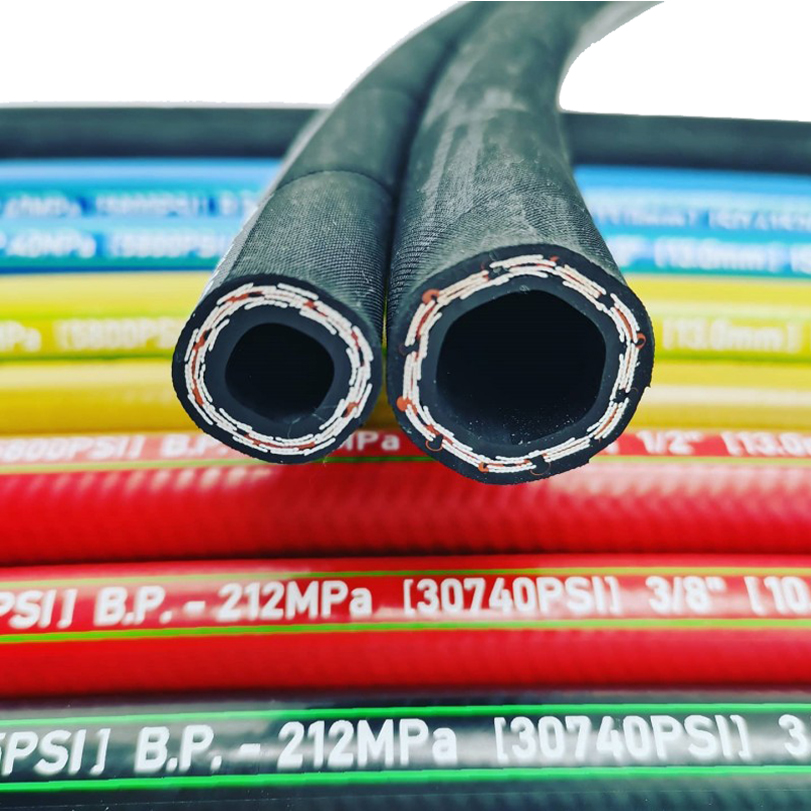
The core material of these hoses is PTFE, a fluoropolymer known for its exceptional chemical inertness, low coefficient of friction, and wide temperature range (-200°C to +260°C). The PTFE resin's molecular weight and crystalline structure directly impact its mechanical properties and processability. Reinforcement materials, typically stainless steel (304, 316L) or Aramid fiber, are crucial for withstanding pressure. Manufacturing begins with PTFE resin powder undergoing a ram extrusion process. Precise temperature control (melt viscosity is highly temperature-dependent) and die design are critical to achieve a seamless, consistent liner. The extruded tube is then sintered to increase density and strength. Reinforcement braiding or spiraling is applied, followed by a final outer layer, often composed of PVC, polyurethane, or woven fabrics for abrasion resistance and environmental protection. Key parameter control includes maintaining consistent resin purity, braid density, curing temperature/time for the outer cover, and dimensional accuracy throughout the process. Specific manufacturing techniques include convoluting the hose to increase flexibility and flaring/fitting attachment methods (crimping, swaging, bonding) that require precise tooling and process control to prevent leaks and failures. The selection of appropriate bonding agents between PTFE and reinforcement is a significant material science challenge; often, surface treatment of the PTFE liner is required to enhance adhesion.
Performance & Engineering
The performance of Teflon flex hoses is governed by several engineering principles. Force analysis focuses on hoop stress generated by internal pressure, which dictates the required reinforcement layer strength. Burst pressure testing, conducted according to ASTM D290 standards, verifies the hose’s ability to withstand extreme pressure without failure. Environmental resistance is paramount, and testing includes exposure to various chemicals (acids, alkalis, solvents) and UV radiation to assess degradation. Permeation resistance, quantified by measuring the rate of fluid transmission through the hose wall, is critical in applications involving hazardous or volatile substances. Flexibility is engineered through hose convolution and material selection. Finite Element Analysis (FEA) is frequently used to model stress distribution under varying pressure and temperature conditions. Compliance requirements include RoHS (Restriction of Hazardous Substances) and REACH (Registration, Evaluation, Authorisation and Restriction of Chemicals) regulations, mandating limitations on specific substances. Furthermore, many applications require adherence to FDA standards (for food-grade materials) or USP Class VI standards (for pharmaceutical applications). Fatigue life, determined through cyclical pressure testing, is a key consideration in dynamic applications like hydraulic systems, predicting the hose’s longevity under repeated stress.
Technical Specifications
| Parameter | Typical Value (China Manufacturers) | Units | Testing Standard |
|---|---|---|---|
| Working Pressure | Up to 3000 | PSI | ASTM D290 |
| Burst Pressure | 6000 - 12000 | PSI | ASTM D290 |
| Temperature Range | -100 to +260 | °C | ASTM D395 |
| Chemical Resistance | Excellent to most chemicals | Qualitative | ASTM D471 |
| PTFE Liner Thickness | 0.8 - 3.2 | mm | Customer Specification |
| Reinforcement Braid | Single or Double Stainless Steel 304/316L | Material | ASTM A975 |
Failure Mode & Maintenance
Common failure modes in Teflon flex hoses include permeation (leading to fluid loss), delamination (separation of layers, causing weakness), cracking (due to fatigue or chemical attack), and fitting failure (leakage at connection points). Permeation is exacerbated by elevated temperatures and pressures, and improper material selection. Delamination often results from inadequate bonding between the PTFE liner and reinforcement, or degradation of the bonding agent. Fatigue cracking occurs under cyclical pressure, particularly in areas of high stress concentration. Chemical attack can degrade the PTFE liner or outer cover. Fitting failures can stem from improper crimping, corrosion, or material incompatibility. Maintenance involves regular visual inspections for signs of cracking, blistering, or abrasion. Pressure testing should be performed periodically to verify integrity. Avoid sharp bends and kinking, which can weaken the hose. When exposed to harsh chemicals, consult a chemical compatibility chart to ensure the hose material is suitable. Replacement is recommended if any signs of damage or degradation are observed. Preventive maintenance, including proper storage (avoiding direct sunlight and extreme temperatures), extends hose lifespan significantly. Root cause failure analysis (RFCA) is critical for identifying systemic issues and implementing corrective actions in manufacturing or application.
Industry FAQ
Q: What is the impact of PTFE resin molecular weight on hose performance?
A: Higher molecular weight PTFE resins generally exhibit improved creep resistance, tensile strength, and chemical inertness. This translates to a longer service life and better performance under high-pressure and high-temperature conditions. However, higher molecular weight resins can be more challenging to process, requiring higher extrusion temperatures and potentially impacting surface finish.
Q: How do different reinforcement materials (stainless steel vs. Aramid) affect hose characteristics?
A: Stainless steel reinforcement provides superior pressure resistance and temperature stability compared to Aramid. Aramid offers a higher strength-to-weight ratio and improved flexibility, making it suitable for applications where weight is a critical factor. However, Aramid is more susceptible to degradation from UV exposure and moisture.
Q: What are the typical VOC emissions associated with PTFE hose manufacturing, and how are they being addressed?
A: VOC emissions primarily originate from the sintering process and the use of solvents during cleaning and bonding. Manufacturers are implementing strategies such as improved ventilation systems, solvent recovery systems, and the use of water-based bonding agents to minimize emissions and comply with environmental regulations.
Q: How does the convolution pitch affect the bend radius and pressure rating of a Teflon flex hose?
A: A tighter convolution pitch (smaller spacing between convolutions) results in a smaller bend radius, enhancing flexibility. However, it also reduces the hose’s ability to withstand pressure, as the convolutions become more susceptible to buckling. A larger pitch increases pressure rating but reduces flexibility.
Q: What quality control measures are commonly employed by China Teflon flex hose manufacturers to ensure product reliability?
A: Common QC measures include raw material inspection (PTFE resin, reinforcement materials), dimensional checks, pressure testing (burst and working pressure), leak testing, visual inspection for defects, and destructive testing to verify mechanical properties. Many manufacturers are also implementing statistical process control (SPC) to monitor and improve process consistency.
Conclusion
China Teflon flex hose manufacturers play a vital role in supplying critical fluid transfer solutions across numerous industries. Their ability to balance cost-effectiveness with stringent performance requirements is paramount. The core technical considerations—material science, manufacturing precision, and rigorous testing—directly impact the hose’s reliability and longevity. The industry faces ongoing challenges related to maintaining consistent material quality, meeting evolving regulatory standards, and optimizing manufacturing processes to minimize environmental impact.
Future advancements will likely focus on developing new PTFE formulations with enhanced properties, incorporating smart sensing technologies for real-time monitoring of hose condition, and implementing more sustainable manufacturing practices. Continued investment in research and development, coupled with a commitment to quality control and customer collaboration, will be essential for China Teflon flex hose manufacturers to maintain their competitive edge in the global market.