
Apr . 01, 2024 17:55 Back to list
china sae100r6 suppliers Performance Analysis

Introduction
SAE 100R6 hose is a non-reinforced rubber hose specifically designed for low-pressure applications, predominantly in industrial and agricultural settings. Chinese SAE 100R6 suppliers have become significant players in the global market, offering competitive pricing and increasingly standardized product quality. This guide provides a detailed technical overview of SAE 100R6 hose, encompassing material science, manufacturing processes, performance characteristics, failure modes, and relevant industry standards. The primary pain points within the industry concerning these suppliers often center around consistent quality control, accurate material certification, and adherence to international safety regulations. This guide aims to address these concerns by providing in-depth technical data for informed procurement decisions. The hose's utility lies in its flexibility for transferring fluids such as air, water, and certain low-pressure chemicals. Understanding its limitations regarding pressure and chemical compatibility is crucial for its effective and safe application.
Material Science & Manufacturing
SAE 100R6 hose typically utilizes a synthetic rubber compound, most commonly SBR (Styrene-Butadiene Rubber) due to its cost-effectiveness and acceptable performance characteristics. However, nitrile rubber (NBR) is also frequently employed for applications requiring enhanced oil resistance. The rubber compound is formulated with plasticizers, reinforcing fillers (such as carbon black), and curing agents to achieve the desired flexibility, tensile strength, and elongation properties. The manufacturing process begins with the mixing of these raw materials in a Banbury mixer or a two-roll mill, ensuring homogeneous dispersion. The mixed compound is then extruded through a die to create a seamless hose tube. Critical parameters during extrusion include temperature control (typically between 120°C and 160°C) to ensure proper viscosity and prevent scorching, and screw speed to maintain consistent material flow. Following extrusion, the hose undergoes vulcanization, a process involving heating the rubber compound with sulfur or other curing agents to create cross-links between the polymer chains, thereby imparting elasticity and durability. Vulcanization time and temperature (typically 140°C to 180°C for 15-30 minutes) are rigorously controlled to achieve optimal mechanical properties. Post-vulcanization, the hose is cooled, inspected for defects, and cut to the specified length. The surface finish is assessed for smoothness and absence of imperfections, and dimensional accuracy is verified using calibrated measuring instruments. Suppliers must maintain strict control over batch-to-batch consistency of the rubber compound to ensure uniform product quality.
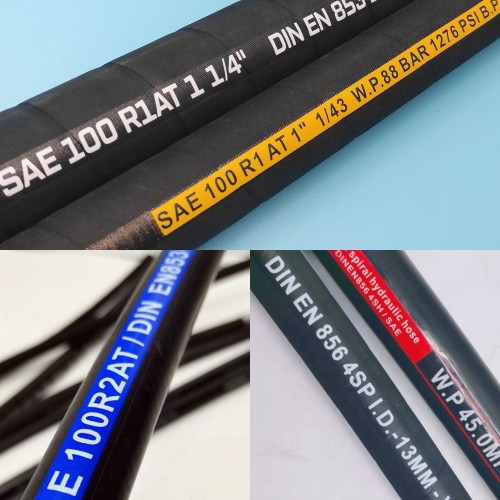
Performance & Engineering
The performance of SAE 100R6 hose is primarily characterized by its working pressure, burst pressure, and temperature range. Working pressure is typically specified as 100 psi (690 kPa) at 73°F (23°C), while burst pressure is generally three times the working pressure. The hose’s operational temperature range commonly extends from -40°F (-40°C) to 212°F (100°C), although this can vary depending on the specific rubber compound used. Force analysis reveals that the tensile strength of the rubber compound is the primary determinant of its resistance to bursting. Tensile strength is determined through standardized testing procedures (ASTM D412) and must meet minimum requirements specified in SAE J517. Environmental resistance is another critical performance parameter. Exposure to ozone, UV radiation, and various chemicals can degrade the rubber compound, leading to loss of flexibility and eventual failure. NBR compounds offer superior resistance to oil and fuel compared to SBR compounds. Compliance requirements dictate that the hose must meet specific standards for material composition, dimensional accuracy, and performance characteristics. SAE J517 outlines the requirements for hydraulic hose, including SAE 100R6. Furthermore, the hose must be capable of withstanding hydrostatic pressure testing without leakage or structural failure. Proper bend radius is crucial to avoid kinking and premature failure; a minimum bend radius of six times the hose’s outer diameter is generally recommended. Engineering considerations also include compatibility with fittings and clamps, ensuring a secure and leak-proof connection.
Technical Specifications
| Parameter | Unit | Typical Value (SBR Compound) | Typical Value (NBR Compound) |
|---|---|---|---|
| Working Pressure | psi | 100 | 100 |
| Burst Pressure | psi | 300 | 300 |
| Temperature Range | °F | -40 to 212 | -40 to 250 |
| Tensile Strength | psi | 1200 | 1500 |
| Elongation at Break | % | 300 | 400 |
| Hardness (Shore A) | - | 60 | 65 |
Failure Mode & Maintenance
Common failure modes for SAE 100R6 hose include fatigue cracking, particularly at the bend radius and fitting connections, due to repeated flexing and pressure cycling. Another prevalent issue is degradation of the rubber compound due to exposure to ozone, UV radiation, and incompatible chemicals. This manifests as surface cracking and loss of elasticity. Abrasion from external factors can also lead to wear and eventual failure. Internal degradation can occur if the hose is used to transport fluids containing abrasive particles. Oxidation, especially at elevated temperatures, can cause the rubber to become brittle and lose its strength. Failure analysis often reveals that improper installation, such as exceeding the minimum bend radius or using incompatible fittings, contributes significantly to premature failure. Maintenance recommendations include regular visual inspection for cracks, abrasions, and swelling. Hose should be replaced immediately if any signs of damage are detected. Avoid exposing the hose to excessive heat, ozone, and incompatible chemicals. Store the hose in a cool, dry place away from direct sunlight. For NBR hoses, periodically check for oil permeation and replace if necessary. Ensure proper fitting installation, using appropriate clamps and tightening them to the manufacturer's specifications. Implement a routine inspection and replacement schedule based on the severity of the application and operating conditions.
Industry FAQ
Q: What is the primary difference between SAE 100R6 and SAE 100R7 hose?
A: SAE 100R7 hose is a reinforced hose, typically with a braided fiber or wire reinforcement, providing significantly higher working pressures (up to 500 psi or higher) and improved burst strength compared to the non-reinforced SAE 100R6 hose, which is limited to 100 psi working pressure. R7 is used in more demanding applications where higher pressures are encountered.
Q: How does the rubber compound affect chemical compatibility?
A: The rubber compound is critical for chemical compatibility. SBR is generally suitable for water and air, while NBR offers superior resistance to oils, fuels, and many industrial chemicals. Exposure to incompatible chemicals can cause swelling, softening, or cracking of the rubber, leading to premature failure. Always consult a chemical compatibility chart before using the hose with a specific fluid.
Q: What are the consequences of exceeding the minimum bend radius?
A: Exceeding the minimum bend radius creates excessive stress on the hose, leading to kinking and localized thinning of the hose wall. This significantly reduces the burst pressure and increases the risk of cracking and failure, particularly under pressure. A minimum bend radius of six times the outer diameter is generally recommended.
Q: What quality control measures should I look for when sourcing from Chinese suppliers?
A: Look for suppliers with ISO 9001 certification, demonstrating a commitment to quality management systems. Request material certificates verifying the rubber compound composition and mechanical properties. Conduct hydrostatic pressure testing on a sample of hoses to verify compliance with SAE J517 standards. Audit the supplier's manufacturing facility to assess their quality control processes and ensure traceability.
Q: How important is proper fitting installation?
A: Proper fitting installation is paramount. Incorrectly installed fittings can create leak paths and stress concentrations, leading to premature failure. Use fittings specifically designed for SAE 100R6 hose and tighten them to the manufacturer's specifications. Ensure the fittings are clean and free from debris before installation. Avoid over-tightening, which can damage the hose or fitting.
Conclusion
SAE 100R6 hose remains a versatile and cost-effective solution for low-pressure fluid transfer applications. However, its performance and longevity are heavily dependent on proper material selection, manufacturing quality, and adherence to operating guidelines. Chinese suppliers offer a competitive sourcing option, but thorough due diligence and rigorous quality control are essential to ensure consistent product reliability and compliance with industry standards.
Understanding the failure modes associated with this type of hose – including fatigue cracking, chemical degradation, and improper installation – allows for proactive maintenance strategies and minimizes the risk of costly downtime. Continued advancements in rubber compound technology and manufacturing processes will likely lead to further improvements in the performance and durability of SAE 100R6 hose, expanding its applicability in a wider range of industrial and agricultural settings.