
Apr . 01, 2024 17:55 Back to list
china profession manufacturer hydraulic hose factory Performance Analysis

Introduction
Hydraulic hoses, manufactured by China profession manufacturer hydraulic hose factory, are critical components in fluid power systems, responsible for the transmission of pressurized hydraulic fluid to actuators and other machinery. These hoses are integral to a broad spectrum of industrial applications including construction, agriculture, manufacturing, mining, and material handling. The performance and reliability of these hoses directly impact system efficiency, safety, and overall operational uptime. This technical guide provides an in-depth analysis of the material science, manufacturing processes, performance characteristics, failure modes, and maintenance procedures related to hydraulic hoses produced by leading Chinese manufacturers. The industry currently faces challenges related to increasingly demanding operating pressures, extreme temperatures, and compatibility with evolving hydraulic fluids – necessitating continuous innovation in hose design and material selection. Achieving optimal hose performance requires a thorough understanding of these factors and adherence to stringent international standards.
Material Science & Manufacturing
The core construction of a hydraulic hose typically comprises an inner tube, reinforcement layers, and an outer cover. The inner tube is commonly composed of synthetic rubbers such as nitrile rubber (NBR), chlorinated polyethylene (CPE), or fluorocarbon rubber (FKM – Viton). NBR offers excellent resistance to petroleum-based hydraulic fluids but has limitations in temperature range. CPE provides enhanced resistance to heat, ozone, and weathering. FKM delivers superior chemical and temperature resistance, making it suitable for demanding applications involving aggressive fluids. Reinforcement layers, providing burst strength, commonly employ high-tensile steel wire (single or multiple spiral layers) or textile braids (typically polyester or aramid fibers). The outer cover is usually constructed from synthetic rubbers like synthetic rubber (SBR), CPE, or polyurethane, offering protection against abrasion, oil, and environmental degradation.
Manufacturing processes begin with the extrusion of the inner tube. Precise control of extrusion temperature, screw speed, and die geometry is critical to ensure consistent wall thickness and smooth internal surface finish. Reinforcement layers are then applied using winding or braiding machines, maintaining constant tension to achieve the desired pressure rating. Outer cover extrusion follows, bonding to the reinforcement layers through vulcanization – a chemical process involving heat and pressure to cross-link the rubber polymers, creating a durable and seamless hose assembly. Quality control during manufacturing includes dimensional checks, pressure testing (to burst and working pressure), and visual inspection for defects. Critical parameters monitored during vulcanization include temperature uniformity, curing time, and pressure distribution to ensure optimal material properties and bonding strength.
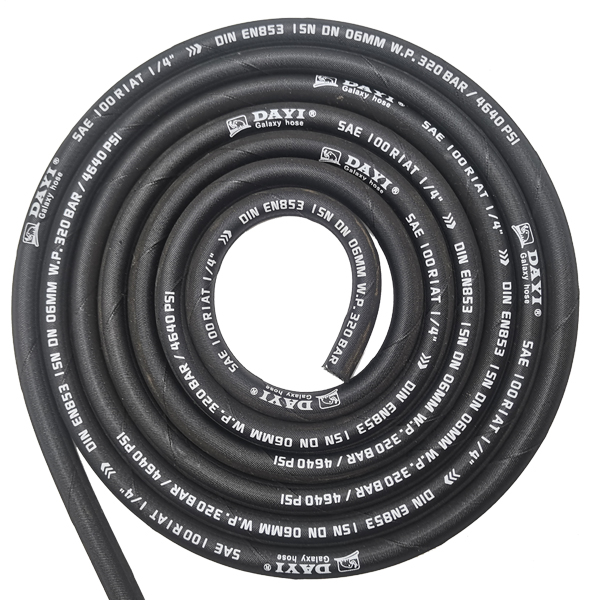
Performance & Engineering
Hydraulic hose performance is dictated by several engineering principles. Burst pressure, the maximum pressure a hose can withstand before failure, is a primary performance metric determined by reinforcement layer construction and material strength. Working pressure, significantly lower than burst pressure, represents the maximum continuous operating pressure. Hose fatigue life, the number of pressure cycles a hose can endure before failure, is crucial in applications with frequent pressure fluctuations. This is influenced by factors like hose material hysteresis, operating temperature, and fluid compatibility.
Environmental resistance is another vital consideration. Exposure to ultraviolet (UV) radiation, ozone, and extreme temperatures can degrade the hose’s outer cover, reducing its flexibility and increasing the risk of cracking. Fluid compatibility is paramount; incompatible fluids can cause swelling, softening, or degradation of the inner tube, leading to leakage and hose failure. Force analysis involves calculating the hoop stress within the hose wall under pressure, ensuring the reinforcement layers can adequately contain the fluid. Compliance with industry standards like SAE J517 (hydraulic hose) and ISO 6898 (hydraulic systems) is essential for ensuring safety and interchangeability.
Technical Specifications
| Parameter | SAE 100 R1 AT | SAE 100 R2 AT | DIN EN 853 1SN | DIN EN 857 2SN |
|---|---|---|---|---|
| Working Pressure (PSI) | 1000 | 1200 | 150 | 210 |
| Burst Pressure (PSI) | 3000 | 3600 | 450 | 630 |
| Temperature Range (°F) | -40 to +212 | -40 to +212 | -40 to +100 | -40 to +100 |
| Inner Tube Material | NBR | NBR | NBR | NBR |
| Reinforcement | Single Steel Wire Braid | Double Steel Wire Braid | Single Steel Wire Braid | Double Steel Wire Braid |
| Cover Material | CPE | CPE | CPE | CPE |
Failure Mode & Maintenance
Common failure modes in hydraulic hoses include burst failure due to exceeding the working pressure, pinhole leaks caused by internal degradation or abrasion, and end connection failures resulting from corrosion or improper assembly. Fatigue cracking develops over time due to cyclic pressure loading, initiating at stress concentration points. Hose kinking, often caused by improper routing or insufficient bend radius, can restrict fluid flow and lead to localized stress. External abrasion, particularly in exposed applications, can compromise the outer cover, allowing moisture and contaminants to penetrate. Internal degradation arises from fluid incompatibility or contamination, causing swelling, softening, or cracking of the inner tube.
Preventive maintenance is crucial for maximizing hose lifespan. Regular visual inspections should identify signs of abrasion, cracking, or leakage. Proper hose routing, avoiding sharp bends and contact with hot surfaces, is essential. Fluid filtration is vital to remove contaminants that can damage the inner tube. End connections should be inspected for corrosion and tightened appropriately. Hose assemblies should be replaced periodically, even if no visible damage is present, adhering to manufacturer recommendations or industry best practices. When replacing hoses, ensure compatibility with the hydraulic fluid and operating conditions. Documenting inspection and maintenance activities provides a valuable record for tracking hose performance and identifying potential issues.
Industry FAQ
Q: What is the impact of hydraulic fluid type on hose selection?
A: Hydraulic fluid type is critical. Petroleum-based fluids generally require NBR inner tubes, while phosphate ester fluids necessitate FKM or other specialized polymers. Incompatible fluids can cause the inner tube to swell, soften, or degrade, leading to leaks and failures. Always verify fluid compatibility before selecting a hose.
Q: How does temperature affect hydraulic hose performance?
A: Extreme temperatures can significantly impact hose performance. High temperatures can accelerate rubber degradation and reduce burst pressure. Low temperatures can decrease hose flexibility and increase the risk of cracking. Choose hoses rated for the expected operating temperature range.
Q: What is the correct bend radius for hydraulic hoses?
A: Maintaining the correct bend radius is vital to prevent kinking and fatigue failure. Too tight a bend induces stress concentration, reducing hose lifespan. The minimum bend radius is typically specified by the hose manufacturer and is dependent on hose size and construction.
Q: How do I identify and address abrasion damage?
A: Regular visual inspections should identify abrasion damage on the outer cover. Minor abrasion can be monitored, but significant damage requires hose replacement. Protecting hoses from abrasion through shielding or routing adjustments is a preventative measure.
Q: What are the key considerations for hose end connections?
A: End connections must be compatible with the hose and the hydraulic system. Proper crimping or swaging is essential to ensure a leak-free seal. Corrosion can weaken end connections, requiring periodic inspection and replacement. Use appropriate sealing methods and torque specifications.
Conclusion
Hydraulic hoses are vital components demanding careful selection, installation, and maintenance. Understanding the interplay between material science, manufacturing processes, and operating conditions is crucial for ensuring reliable performance and maximizing service life. China profession manufacturer hydraulic hose factory, through its commitment to quality control and adherence to international standards, provides solutions designed to withstand the rigorous demands of modern hydraulic systems. Continuous monitoring of hose condition, proactive maintenance practices, and informed material selection are paramount to preventing failures and optimizing system efficiency.
Future developments in hydraulic hose technology will likely focus on lighter-weight materials, improved abrasion resistance, and enhanced chemical compatibility. The integration of sensor technology for real-time condition monitoring is also anticipated, allowing for predictive maintenance and reduced downtime. Adhering to evolving industry standards and embracing innovative materials will be key to meeting the ever-increasing performance requirements of hydraulic systems across diverse industrial applications.