
Apr . 01, 2024 17:55 Back to list
china high pressure rubber hose manufacturers Performance Analysis

Introduction
High-pressure rubber hoses manufactured in China are critical components in a diverse range of industrial applications, including hydraulic systems, oil & gas exploration, chemical processing, and automotive engineering. These hoses transmit fluids and gases under substantial pressure, demanding stringent manufacturing standards and material specifications. Their technical position in the industry chain lies between raw material suppliers (rubber compounds, steel wire) and end-users who integrate them into complex machinery and infrastructure. Core performance characteristics revolve around burst pressure, working pressure, temperature resistance, chemical compatibility, and service life. A key challenge facing end-users is ensuring consistent quality and adherence to international standards, given the wide variation in manufacturer capabilities within China. This guide provides an in-depth analysis of the materials, manufacturing processes, performance parameters, failure modes, and maintenance practices associated with these critical industrial components.
Material Science & Manufacturing
The core material in high-pressure rubber hoses is a synthetic rubber compound, typically a blend of several elastomers to achieve specific performance characteristics. Common elastomers include Nitrile Rubber (NBR) for oil resistance, Ethylene Propylene Diene Monomer (EPDM) for heat and weather resistance, and Chloroprene Rubber (CR) for flame resistance and abrasion resistance. The rubber compound is reinforced with high-tensile steel wire, spirally wound or braided within the rubber matrix to provide the necessary burst strength. The steel wire itself is typically high-carbon steel, undergoing surface treatment to enhance adhesion to the rubber. Manufacturing begins with the preparation of the rubber compound, meticulously mixing elastomers, fillers (carbon black, silica), plasticizers, and curing agents. The mixing process is critical for achieving homogenous dispersion and influencing the final mechanical properties. Hoses are then built up layer by layer on a mandrel, utilizing extrusion and calendaring techniques. The steel wire reinforcement is applied simultaneously. A crucial parameter is the wire tension during winding, directly impacting hose burst pressure. After assembly, the hose undergoes vulcanization – a curing process involving heat and pressure – to crosslink the rubber molecules, transforming it from a pliable material into a durable elastomer. Temperature and curing time are rigorously controlled, as under-curing leads to insufficient strength, while over-curing can cause brittleness. Post-vulcanization, hoses are trimmed, inspected for defects (voids, cracks, uneven wire distribution), and pressure tested to verify performance.
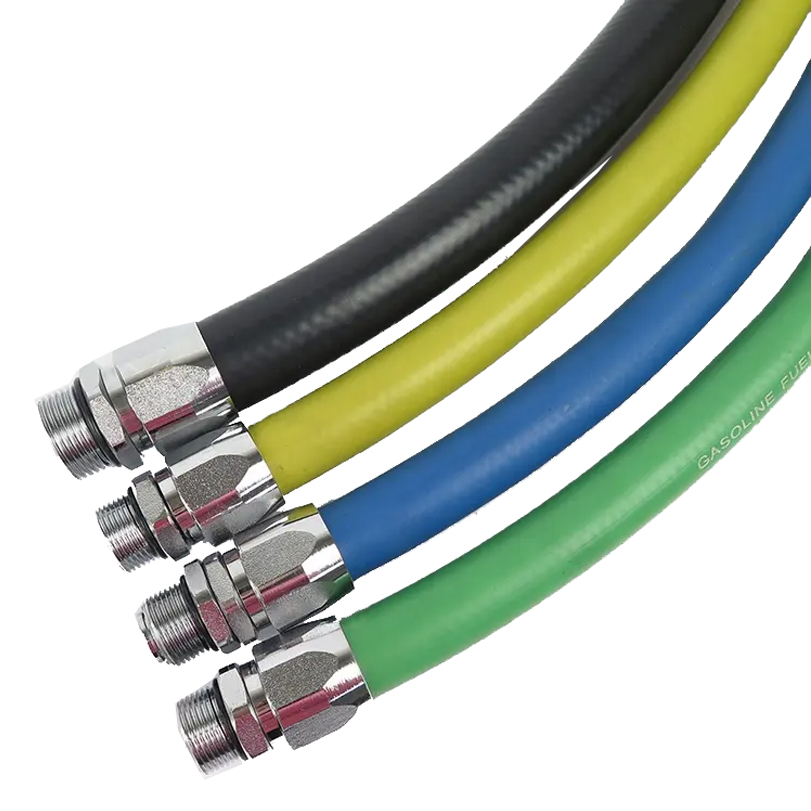
Performance & Engineering
The primary performance parameter for high-pressure hoses is burst pressure, defined as the pressure at which the hose fails catastrophically. Working pressure, typically a fraction (often 50-70%) of the burst pressure, represents the maximum safe operating pressure. Force analysis involves calculating hoop stress within the hose wall under pressure, considering the radial and tangential components. Finite Element Analysis (FEA) is increasingly used to model stress distribution and optimize hose design. Environmental resistance is paramount, particularly chemical compatibility. Exposure to incompatible fluids can cause swelling, degradation, and ultimately, failure. Temperature fluctuations also impact performance; elevated temperatures reduce rubber elasticity and strength, while low temperatures can induce brittleness. Compliance requirements vary by industry and geographical location. For hydraulic applications, ISO 6049 and SAE J517 standards define performance criteria. Oil & gas applications often require adherence to API standards. A critical engineering consideration is hose bend radius. Exceeding the minimum bend radius induces stress concentration, reducing service life. Proper hose routing and support are essential to prevent kinking and abrasion, both common causes of premature failure. The selection of appropriate end fittings (crimped or swaged) is also vital, ensuring a leak-proof and structurally sound connection.
Technical Specifications
| Parameter | Unit | Typical Value (DN20 Hose) | Testing Standard |
|---|---|---|---|
| Working Pressure | MPa | 20 | ISO 6049 |
| Burst Pressure | MPa | 80 | ISO 6049 |
| Temperature Range | °C | -40 to +100 | SAE J517 |
| Inner Tube Material | - | NBR (Nitrile Rubber) | ASTM D2000 |
| Reinforcement | - | High-Tensile Steel Wire Braid (4 Spiral) | ISO 3864 |
| Outer Cover Material | - | CR (Chloroprene Rubber) | ASTM D2000 |
Failure Mode & Maintenance
High-pressure rubber hoses are susceptible to several failure modes. Fatigue cracking, caused by repeated pressure cycling, initiates at stress concentration points (e.g., near fittings). Delamination, the separation of rubber layers, occurs due to poor adhesion between the rubber and reinforcement. Degradation, resulting from exposure to incompatible fluids or UV radiation, reduces rubber elasticity and strength. Oxidation, a chemical reaction with oxygen, causes hardening and cracking. Abrasion, due to external contact with abrasive surfaces, compromises the outer cover and exposes the reinforcement. Internal erosion, from fluid particulate matter, damages the inner tube. Maintenance primarily focuses on preventative measures. Regular visual inspections are crucial, looking for cracks, bulges, abrasions, and leaks. Hose routing should be optimized to minimize bending and abrasion. Pressure surges should be dampened using accumulators or pressure relief valves. Fluid cleanliness is paramount; filtration systems should be employed to remove particulate contaminants. Hoses should be replaced based on a pre-determined schedule, or whenever signs of degradation are observed. Proper storage is also vital; hoses should be stored in a cool, dry, and dark environment, away from ozone and direct sunlight. When replacing hoses, it is essential to use compatible end fittings and follow the manufacturer's recommended crimping or swaging procedures.
Industry FAQ
Q: What is the impact of different steel wire braid configurations (2, 4, 6 spiral) on hose performance?
A: Increasing the number of steel wire spirals directly correlates with increased burst pressure and kink resistance. A 2-spiral braid offers flexibility but lower pressure capacity. A 4-spiral braid provides a good balance between flexibility and pressure handling. A 6-spiral braid offers the highest pressure capacity and kink resistance, but is significantly less flexible. The choice depends on the specific application requirements and operating conditions.
Q: How does the choice of rubber compound affect chemical compatibility and service life?
A: Rubber compound selection is critical. NBR offers excellent oil resistance but poor resistance to ozone and weathering. EPDM provides superior resistance to heat, ozone, and weathering, but limited oil resistance. CR offers good abrasion and flame resistance. The specific fluid being conveyed must be considered, and the rubber compound chosen accordingly. Incorrect compound selection can lead to rapid degradation and premature failure.
Q: What are the key considerations when selecting hose end fittings?
A: End fittings must be compatible with the hose material, pressure rating, and fluid being conveyed. The fitting material (steel, stainless steel, brass) should resist corrosion from the fluid. Crimping or swaging procedures must be performed correctly to ensure a leak-proof and structurally sound connection. Improperly installed fittings are a common cause of hose failure.
Q: What is the role of internal hose smoothness on flow rate and pressure drop?
A: A smoother internal surface reduces friction, resulting in higher flow rates and lower pressure drop. Roughness increases turbulence and energy loss. Internal surface smoothness is typically specified as a Ra value (average roughness). Maintaining internal smoothness requires careful manufacturing processes and prevention of internal contamination.
Q: How do international standards (ISO, SAE, API) differ in their requirements for high-pressure hoses?
A: ISO standards (e.g., ISO 6049) are widely adopted globally and provide comprehensive performance testing criteria. SAE standards (e.g., SAE J517) are primarily used in North America and focus on hydraulic applications. API standards are specific to the oil & gas industry and address stringent safety and reliability requirements. Compliance with the appropriate standard is critical for ensuring product safety and performance.
Conclusion
High-pressure rubber hoses from Chinese manufacturers represent a critical link in numerous industrial processes. Their performance is dictated by a complex interplay of material science, manufacturing precision, and adherence to stringent quality control procedures. Understanding the nuances of rubber compound selection, reinforcement techniques, and environmental resistance is crucial for ensuring reliable operation and preventing catastrophic failures.
Future trends in this sector include the development of lighter-weight hoses utilizing advanced materials, the integration of smart sensors for real-time condition monitoring, and the adoption of more sustainable manufacturing practices. Continued investment in research and development, coupled with rigorous quality assurance programs, will be essential for Chinese manufacturers to maintain their competitive edge in the global market and meet the evolving demands of the industry.