
Apr . 01, 2024 17:55 Back to list
china high pressure hydraulic rubber hose manufacturers Performance Analysis
Introduction
High-pressure hydraulic rubber hoses manufactured in China are critical components in a wide array of industrial and mobile applications, including construction equipment, agricultural machinery, material handling vehicles, and manufacturing systems. These hoses are engineered to safely transmit hydraulic fluid under extreme pressures, enabling efficient power transfer and precise control. Positioned within the fluid power industry chain, these hoses represent a vital interface between hydraulic power units, control valves, and hydraulic actuators. Core performance characteristics center on burst pressure, working pressure, temperature resistance, and fluid compatibility. A key challenge for end-users is balancing cost-effectiveness with demonstrable reliability and adherence to international safety standards, particularly given the complexities of global supply chains and the potential for substandard materials. This guide provides an in-depth technical overview of these hoses, covering material science, manufacturing processes, performance characteristics, failure modes, and relevant industry standards.
Material Science & Manufacturing
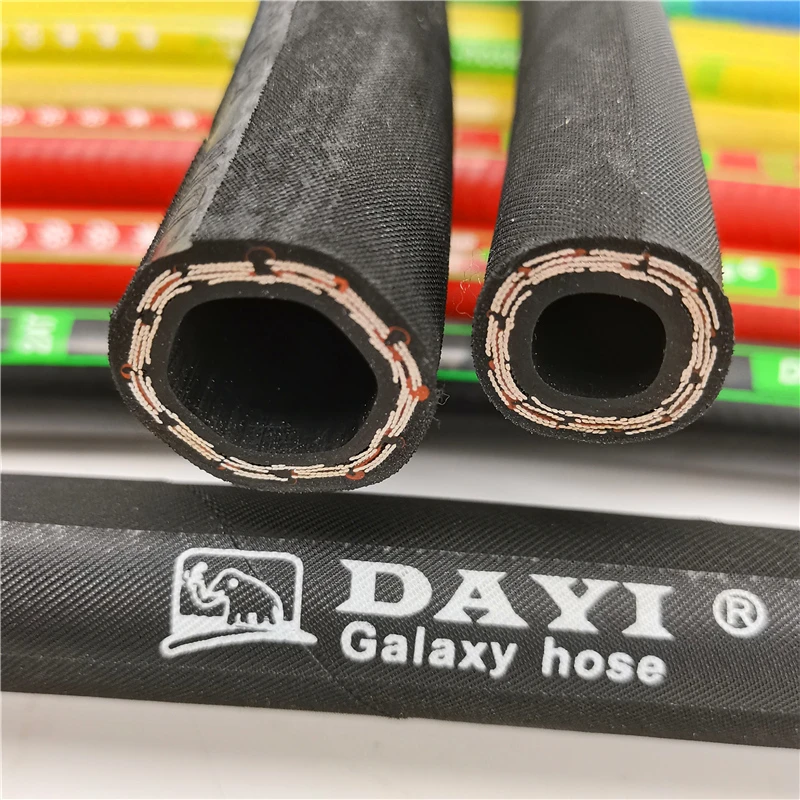
The construction of a high-pressure hydraulic rubber hose typically involves four key layers: the inner tube, reinforcement layers, outer cover, and sometimes an intermediate layer (skiving). The inner tube is commonly formulated from synthetic rubbers, predominantly nitrile rubber (NBR) for petroleum-based fluids, or fluoroelastomers (FKM) like Viton for applications requiring resistance to aggressive chemicals or high temperatures. NBR provides good abrasion resistance and is cost-effective, but its temperature range is limited. FKM offers superior chemical and temperature resistance but at a higher cost. Manufacturing the inner tube involves mixing the rubber compound, extrusion through a die to achieve the desired bore size and wall thickness, and subsequent vulcanization (curing) to impart elasticity and strength. Reinforcement layers typically consist of multiple braids of high-tensile steel wire. The number of braids dictates the hose's working and burst pressure capabilities. Spiral-wound reinforcement using single or multiple steel wires is also common in high-pressure applications. The outer cover is generally composed of synthetic rubber, such as chloroprene rubber (CR) or styrene-butadiene rubber (SBR), providing abrasion, ozone, and weather resistance. Skiving, a process of reducing the outer cover thickness at the hose ends, facilitates proper fitting attachment. Key parameters controlled during manufacturing include rubber compound viscosity, wire tensile strength, braid angle, vulcanization temperature and time, and dimensional accuracy. Quality control rigorously assesses these parameters to ensure consistent performance and prevent premature failure. A critical aspect involves adhesion testing between layers to prevent delamination under pressure.

Performance & Engineering
The performance of a high-pressure hydraulic hose is governed by several critical engineering parameters. Burst pressure, the maximum pressure the hose can withstand before rupture, is a fundamental specification. Working pressure, typically a fraction (e.g., 1/4) of the burst pressure, represents the maximum recommended operating pressure. Temperature resistance is crucial, as both high and low temperatures can degrade rubber compounds, reducing flexibility and increasing the risk of failure. Fluid compatibility is paramount; incompatible fluids can cause swelling, softening, or cracking of the inner tube. Hose bend radius is also critical; exceeding the minimum bend radius can lead to kinking and hose failure. Force analysis focuses on hoop stress within the hose wall, calculated using the thin-walled pressure vessel formula (σ = Pr/t, where σ is hoop stress, P is pressure, r is inner radius, and t is wall thickness). Environmental resistance encompasses protection against ozone, UV radiation, and abrasion. Compliance requirements, as outlined by SAE, EN, and DIN standards, dictate testing procedures and performance criteria. Fitting selection is crucial; improper fittings can cause leaks or catastrophic failure. Considerations include fitting material compatibility, crimp specifications, and fitting pressure ratings. Fatigue life, the number of pressure cycles a hose can withstand before failure, is a significant performance metric, particularly in dynamic applications.
Technical Specifications
| Parameter | Unit | SAE J517 100R2AT | EN 853 2SN |
|---|---|---|---|
| Working Pressure | MPa | 31.5 | 20 |
| Burst Pressure | MPa | 105 | 60 |
| Temperature Range | °C | -40 to +100 | -40 to +70 |
| Inner Tube | Material | Synthetic Rubber (NBR) | Synthetic Rubber (NBR) |
| Reinforcement | Material | Two Steel Wire Braids | Two Steel Wire Spirals |
| Outer Cover | Material | Synthetic Rubber (CR) | Synthetic Rubber (CR) |
Failure Mode & Maintenance
High-pressure hydraulic rubber hoses are susceptible to several failure modes. Fatigue cracking, initiated by repeated pressure cycling, typically occurs at the crimp connection or within the reinforcement layers. Delamination, the separation of layers, can occur due to inadequate adhesion between the rubber and reinforcement. Degradation of the rubber compound, caused by exposure to high temperatures, aggressive fluids, or UV radiation, can lead to cracking and loss of flexibility. Oxidation, particularly in the outer cover, can result in surface cracking and reduced abrasion resistance. Abrasion, caused by contact with abrasive surfaces, can wear through the outer cover, exposing the reinforcement layers. Kinking, resulting from exceeding the minimum bend radius, can restrict flow and cause localized stress concentrations. Internal erosion, caused by particulate contamination in the hydraulic fluid, can gradually wear away the inner tube. Maintenance practices include regular visual inspection for signs of damage, such as cracks, blisters, or abrasions. Hose routing should be carefully planned to avoid sharp bends, abrasion points, and exposure to extreme temperatures. Hydraulic fluid should be kept clean and filtered to prevent internal erosion. Hose assemblies should be replaced at recommended intervals, even if no visible damage is present. Proper crimping procedures are essential to ensure a secure connection between the hose and fittings. A comprehensive hose management program, including documentation of hose identification, installation dates, and maintenance records, can significantly improve reliability and reduce the risk of catastrophic failure.
Industry FAQ
Q: What is the significance of the “dash size” designation (e.g., -6, -8, -10) in hydraulic hose specifications?
A: The dash size refers to the hose's inner diameter in sixteenths of an inch. For example, a -6 hose has a 6/16 inch (or 3/8 inch) inner diameter. It's a fundamental parameter used for flow rate calculations and fitting selection. Incorrect dash sizing will lead to flow restriction or fitting incompatibility.
Q: How does steel wire braid construction impact a hose's pressure rating and flexibility?
A: Increasing the number of braid layers significantly increases the hose’s burst and working pressure capabilities. However, adding more layers also reduces the hose’s flexibility, making it more difficult to route in tight spaces. Spiral wire reinforcement provides higher pressure ratings with greater flexibility compared to braided hoses.
Q: What are the critical considerations for selecting the correct hydraulic fluid for a specific hose type?
A: Fluid compatibility is paramount. Using an incompatible fluid can cause swelling, softening, or cracking of the inner tube, leading to premature failure. NBR hoses are generally suitable for petroleum-based fluids, while FKM hoses are required for aggressive fluids like phosphate esters or high-temperature synthetic fluids. Always consult the hose manufacturer's fluid compatibility chart.
Q: What is the proper procedure for crimping hose fittings to ensure a leak-free connection?
A: Proper crimping requires a calibrated crimping machine and dies specifically designed for the hose and fitting combination. The crimp must achieve the correct depth and ovality to create a permanent, leak-proof seal. Over-crimping can damage the hose reinforcement, while under-crimping can lead to leaks or fitting blow-off.
Q: What role do international standards (SAE, EN, DIN) play in ensuring hydraulic hose quality and safety?
A: International standards provide consistent testing procedures, performance criteria, and marking requirements for hydraulic hoses. Compliance with these standards ensures that the hose meets minimum safety and performance standards. Reputable manufacturers will clearly indicate compliance with relevant standards on their product markings.
Conclusion
China’s high-pressure hydraulic rubber hose manufacturers play a vital role in global fluid power infrastructure. Understanding the intricate interplay between material science, manufacturing precision, and rigorous engineering principles is paramount for ensuring reliable and safe operation. The selection of appropriate materials, meticulous control of manufacturing parameters, and strict adherence to international standards are essential for mitigating failure modes and maximizing service life.
Future advancements in hydraulic hose technology will likely focus on developing lighter-weight materials, improving temperature and chemical resistance, and incorporating smart sensing capabilities for real-time monitoring of hose condition. A proactive approach to hose management, encompassing regular inspection, preventive maintenance, and adherence to recommended replacement schedules, remains the cornerstone of long-term reliability and operational safety.