
Apr . 01, 2024 17:55 Back to list
china flexible ptfe hose manufacturer Performance Analysis

Introduction
Flexible Polytetrafluoroethylene (PTFE) hose, manufactured in China, represents a critical component across diverse industrial applications demanding high chemical resistance, temperature stability, and flexibility. Positioned within the fluid transfer industry, these hoses serve as alternatives to metallic tubing and other polymeric hoses in environments where conventional materials degrade or fail. The core performance characteristics – encompassing broad chemical compatibility, a wide operating temperature range (-100°C to +260°C), and low friction coefficient – establish PTFE hoses as a specialized solution for aggressive media transfer. Chinese manufacturers have become significant global suppliers, focusing on competitive pricing and increasingly sophisticated manufacturing techniques to meet international quality standards. This guide provides an in-depth analysis of these hoses, from material science and manufacturing processes to performance engineering, failure modes, and relevant industry standards.
Material Science & Manufacturing
The foundation of flexible PTFE hose lies in the unique properties of Polytetrafluoroethylene. PTFE is a synthetic fluoropolymer comprising solely of carbon and fluorine atoms. Its inherent chemical inertness stems from the strong carbon-fluorine bonds, rendering it unaffected by most acids, bases, and solvents. Raw material selection focuses on virgin PTFE resin, categorized by molecular weight and particle size distribution, impacting processability and final product mechanical strength. Manufacturing typically involves several stages: paste extrusion, sintering, and often, liner bonding and braiding. Paste extrusion, utilizing a dispersion of PTFE particles in a liquid carrier, forms the initial hose profile. This is followed by sintering, a heat treatment process removing the carrier and fusing the PTFE particles, creating a porous structure. To enhance burst pressure resistance, a stainless steel braiding is commonly applied externally. Liner bonding, employing a compatible adhesive like FEP (Fluorinated Ethylene Propylene), bonds the PTFE to the braid. Critical parameters include extrusion temperature, sintering rate (heating ramp-up and cool-down), braiding density, and adhesive application uniformity. Controlling these variables is paramount to achieving desired wall thickness, porosity, and mechanical integrity. Filler materials, such as glass fiber, may be incorporated to enhance stiffness and reduce creep, but can compromise chemical resistance if not fully encapsulated by the PTFE matrix.
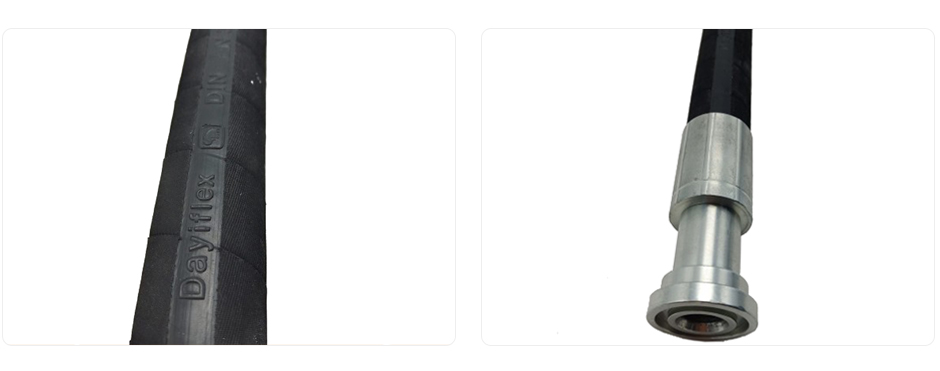
Performance & Engineering
The performance of flexible PTFE hose is governed by a complex interplay of material properties and structural design. Burst pressure, a critical performance parameter, is determined by the PTFE wall thickness, braid material, braid angle, and hose diameter. Force analysis involves evaluating hoop stress within the PTFE wall and tensile stress in the reinforcement braid under internal pressure. Finite Element Analysis (FEA) is routinely employed to optimize hose geometry and reinforcement configuration. Environmental resistance is exceptional, with PTFE exhibiting negligible degradation from UV exposure, ozone, and weathering. However, prolonged exposure to high temperatures (above 260°C) can lead to thermal decomposition and release of harmful fluorinated compounds. Conformity to industry standards, such as SAE J526 for automotive fuel systems and FDA 21 CFR 177.1550 for food and pharmaceutical applications, dictates permissible operating conditions and material purity. Flexibility, quantified by bend radius, is a function of hose diameter and wall thickness; tighter bend radii necessitate thinner walls, compromising burst pressure. Chemical compatibility is exceptionally broad but is not absolute; certain highly reactive substances like molten alkali metals can attack PTFE. Electrical resistance is also a key parameter, with PTFE functioning as an excellent insulator, beneficial in applications involving conductive fluids.
Technical Specifications
| Parameter | Unit | Standard Specification | Typical Value (China Manufactured Hose) |
|---|---|---|---|
| Operating Pressure | MPa | SAE J526 | Up to 4.2 MPa |
| Burst Pressure | MPa | ASTM D1430 | Typically 3x Operating Pressure |
| Temperature Range | °C | PTFE Material Specification | -100 to +260 |
| Chemical Resistance | - | ASTM F1554 Class A | Excellent to most chemicals |
| Tensile Strength | MPa | ASTM D4895 | 20-30 (PTFE only) |
| Elongation at Break | % | ASTM D4895 | 100-300 (PTFE only) |
Failure Mode & Maintenance
Failure modes in flexible PTFE hose are primarily linked to mechanical stress, thermal degradation, and chemical attack. Fatigue cracking, induced by repeated flexing and pressure cycling, is a common failure mechanism, particularly at connection points. Delamination, the separation of PTFE from the reinforcement braid, can occur due to inadequate adhesive bonding or excessive strain. Chemical attack, while rare, can happen with specific aggressive substances, leading to swelling, embrittlement, and eventual permeation. Oxidation at elevated temperatures, though slow, degrades PTFE, reducing its mechanical properties and releasing fluorinated compounds. Permeation, the migration of fluids through the hose wall, can occur with certain gases and low-molecular-weight liquids. Maintenance involves regular visual inspection for cracks, abrasions, and swelling. Connection fittings should be checked for tightness and corrosion. Avoid exceeding the specified operating pressure and temperature limits. Do not expose the hose to incompatible chemicals. Cleaning can be performed with mild detergents and water; avoid harsh solvents. If damage is detected, the hose should be replaced immediately. Proper storage, shielded from direct sunlight and extreme temperatures, extends service life. Periodic pressure testing, using a hydrostatic test, can identify potential weaknesses before catastrophic failure.
Industry FAQ
Q: What is the primary difference between convoluted and smooth bore PTFE hose, and how does this impact flow characteristics?
A: Convoluted PTFE hose features a ribbed internal surface to enhance flexibility, particularly in tight spaces. This increased flexibility comes at the cost of increased flow restriction and turbulence, leading to a higher pressure drop compared to smooth bore hose. Smooth bore hose offers lower friction and optimized flow rates, but is less flexible. The selection depends on the application’s priority – flexibility versus flow efficiency.
Q: How do Chinese PTFE hose manufacturers ensure compliance with FDA regulations for food and pharmaceutical applications?
A: Reputable Chinese manufacturers employ strict quality control measures throughout the production process, utilizing virgin PTFE resins that meet FDA 21 CFR 177.1550 standards. This includes traceability of raw materials, rigorous testing for extractables and leachables, and adherence to Good Manufacturing Practices (GMP). Certification documentation is typically provided upon request.
Q: What are the limitations of PTFE hose when handling static-dissipative fluids?
A: PTFE is inherently an excellent electrical insulator. When handling static-dissipative fluids, charge buildup can occur, potentially leading to electrostatic discharge (ESD). To mitigate this, conductive PTFE formulations, incorporating carbon black or other conductive fillers, are available. However, these fillers can slightly compromise chemical resistance.
Q: Can PTFE hose be repaired if a small leak develops?
A: Repairing PTFE hose is generally not recommended. The PTFE material is difficult to bond reliably, and any attempt to patch a leak introduces a potential failure point. Replacement of the entire hose assembly is the safest and most reliable solution.
Q: What is the expected service life of a PTFE hose in a typical chemical processing application?
A: The service life varies significantly depending on operating conditions, chemical exposure, and mechanical stress. However, a well-maintained PTFE hose can typically provide 5-10 years of reliable service in a typical chemical processing environment. Regular inspection and adherence to operating limits are crucial for maximizing longevity.
Conclusion
Flexible PTFE hose manufactured in China offers a compelling combination of chemical resistance, temperature stability, and flexibility, making it a vital component across numerous industries. Understanding the underlying material science – the unique properties of PTFE and the impact of manufacturing parameters – is crucial for selecting the appropriate hose for specific applications. Careful consideration of performance specifications, potential failure modes, and adherence to relevant industry standards will ensure optimal performance and longevity.
The increasing sophistication of Chinese manufacturing capabilities positions these producers as reliable partners in supplying high-quality PTFE hose. Continued advancements in material formulations, braiding techniques, and quality control processes will further enhance the performance and broaden the applications of this essential industrial component. Prioritizing thorough evaluation and selecting a reputable manufacturer are key to realizing the full benefits of this technology.