
Apr . 01, 2024 17:55 Back to list
china best price hydraulic hose manufacturer Performance Analysis

Introduction
Hydraulic hoses, integral components in fluid power systems, transmit hydraulic fluid to operate machinery across diverse sectors including construction, agriculture, manufacturing, and transportation. China has emerged as a leading global manufacturer of hydraulic hoses, offering competitive pricing without necessarily compromising performance. This technical guide provides an in-depth exploration of hydraulic hose technology, focusing on the critical aspects of material science, manufacturing processes, performance characteristics, potential failure modes, and relevant industry standards. The emphasis will be on understanding the engineering principles governing hose selection and maintenance, addressing the common pain points experienced by procurement managers and engineers when sourcing from international suppliers. A key consideration is balancing cost-effectiveness with long-term reliability and adherence to stringent safety regulations. This document aims to bridge the gap between technical specifications and practical application, providing a comprehensive resource for informed decision-making.
Material Science & Manufacturing
The core of a hydraulic hose's performance lies in its material composition. Historically, natural rubber was prevalent, but modern hoses overwhelmingly utilize synthetic elastomers due to superior resistance to oil, heat, and abrasion. The most common elastomer is nitrile rubber (NBR), offering excellent resistance to petroleum-based fluids. However, specialized applications demand materials like ethylene propylene diene monomer (EPDM) for phosphate ester fluids, or fluorocarbon (FKM/Viton) for high-temperature, aggressive chemical environments. Reinforcement layers are equally critical. High tensile strength steel wire is standard for medium to high-pressure applications, with the number of spiral layers determining the hose's working pressure. Textile reinforcement (typically polyester or aramid fibers) is used in lower-pressure applications where flexibility is paramount.
Manufacturing processes vary based on hose type. Braided hoses involve helically winding steel wire around a central rubber tube, followed by vulcanization – a chemical process that crosslinks the elastomer molecules, imparting strength, elasticity, and resistance to degradation. Spiral hoses are constructed by continuously winding steel wire around a central core, creating a more robust and higher-pressure capacity hose. Extrusion is fundamental to shaping the inner tube and cover layers. Critical parameters during extrusion include die temperature, screw speed, and pressure to ensure dimensional accuracy and consistent material properties. Post-extrusion processes like curing (vulcanization) are tightly controlled for time, temperature, and pressure to optimize elastomer characteristics. Quality control involves rigorous testing of material tensile strength, elongation, and hardness, as well as dimensional checks to ensure adherence to specifications. The selection of rubber compounds and reinforcement materials is driven by the application’s fluid compatibility, temperature range, pressure requirements, and desired hose life. Proper bonding between the rubber and reinforcement is critical to prevent separation, a common failure mode.
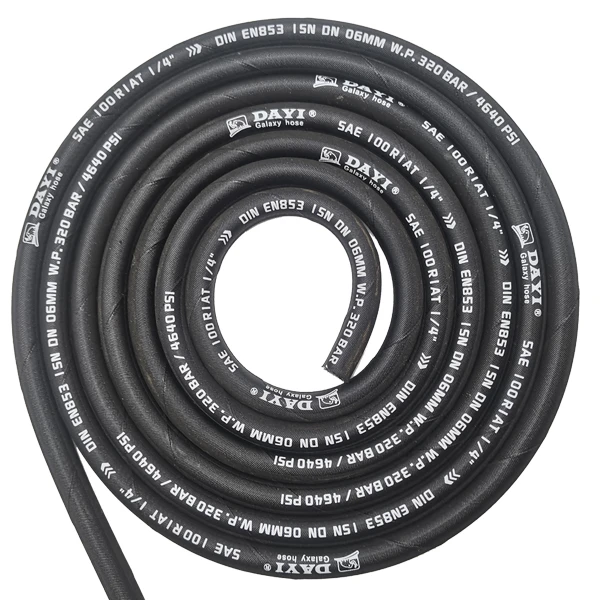
Performance & Engineering
Hydraulic hose performance is fundamentally governed by pressure rating, temperature range, and fluid compatibility. The working pressure is typically defined as the maximum sustained pressure at which the hose can operate safely for a specified period. Burst pressure is significantly higher, representing the pressure at which the hose will rupture. A safety factor is always applied between working and burst pressure. Temperature significantly impacts elastomer properties; exceeding the recommended temperature range can lead to hardening, cracking, and reduced flexibility. Fluid compatibility is crucial – incompatible fluids can cause swelling, softening, or degradation of the elastomer, leading to premature failure.
Engineering considerations extend to hose bend radius, which must be maintained above the manufacturer’s minimum specification to prevent kinking and stress concentration. Hose twist is another critical factor; excessive twisting can reduce flow, induce fatigue, and damage the reinforcement layers. Fatigue analysis is employed to predict hose life under cyclic loading conditions. Finite element analysis (FEA) is used to simulate stress distribution within the hose structure under various operating conditions. Compliance requirements, such as those specified by SAE (Society of Automotive Engineers) and EN (European Norms), dictate testing procedures and performance criteria. For example, SAE J517 specifies performance requirements for hydraulic hoses, including pressure testing, impulse testing, and temperature cycling. Proper fitting selection and installation are paramount; incompatible fittings or improper crimping can compromise hose integrity and lead to leaks or failures.
Technical Specifications
| Parameter | SAE 100R1AT | SAE 100R2AT | DIN EN 853 1SN | DIN EN 857 1SC |
|---|---|---|---|---|
| Working Pressure (PSI) | 600 | 1200 | 400 | 1500 |
| Burst Pressure (PSI) | 2400 | 4800 | 1600 | 6000 |
| Temperature Range (°F) | -40 to 212 | -40 to 212 | -40 to 212 | -40 to 248 |
| Reinforcement | Single Steel Wire Braid | Double Steel Wire Braid | Single Steel Wire Spiral | Double Steel Wire Spiral |
| Cover Material | Synthetic Rubber (NBR) | Synthetic Rubber (NBR) | Synthetic Rubber (NBR) | Synthetic Rubber (NBR) |
| Fluid Compatibility | Petroleum-based fluids | Petroleum-based fluids | Petroleum-based fluids | Petroleum-based fluids |
Failure Mode & Maintenance
Hydraulic hose failures typically stem from several key mechanisms. Fatigue cracking, caused by repeated bending and pressure cycling, is a common mode, often initiating at the fitting crimp or areas of stress concentration. Abrasion, resulting from external contact with surfaces, erodes the cover layer, exposing the reinforcement and leading to corrosion. Oil permeation, particularly with incompatible fluids, causes swelling and softening of the elastomer, reducing its strength and flexibility. Impact damage, from accidental strikes, can rupture the hose or damage the reinforcement. Internal corrosion, induced by moisture or chemical contamination, weakens the hose from within.
Preventative maintenance is crucial. Regular visual inspections should be conducted to identify signs of abrasion, cracking, bulging, or leaks. Hose routing should be optimized to minimize bending and twisting. Protect hoses from excessive heat, chemicals, and physical damage. Ensure proper fitting selection and crimping. Fluid cleanliness is paramount; filtration systems should be used to remove contaminants that can accelerate wear. Implement a hose replacement schedule based on operating conditions and hose age. When replacing a hose, always use the correct specifications and ensure compatibility with the hydraulic system. Pressure testing after installation is recommended to verify leak-free operation. Documenting hose inspection and maintenance records is essential for tracking performance and identifying potential issues.
Industry FAQ
Q: What is the significance of the "dash size" in hydraulic hose specification?
A: The "dash size" (e.g., -4, -6, -8) directly correlates to the internal diameter of the hose in sixteenths of an inch. Therefore, a -8 hose has an internal diameter of 8/16 or 1/2 inch. This is a critical parameter for ensuring adequate flow capacity for the hydraulic system. Using an undersized hose will result in excessive pressure drop and reduced performance.
Q: How does temperature affect the working pressure of a hydraulic hose?
A: Elevated temperatures generally reduce the working pressure capacity of a hydraulic hose. Elastomers lose strength and flexibility at higher temperatures. Hose manufacturers provide derating factors that specify the allowable working pressure at different temperatures. It’s vital to consult the manufacturer's specifications and apply these derating factors to ensure safe operation.
Q: What are the key differences between braided and spiral hydraulic hoses?
A: Braided hoses offer greater flexibility, making them suitable for applications with tight bend radii. Spiral hoses, constructed with continuously wound wire, provide significantly higher pressure ratings and greater resistance to bursting. Spiral hoses are often preferred for high-pressure, demanding applications.
Q: What is the importance of proper hose crimping?
A: Proper crimping is absolutely essential for creating a leak-free and secure connection between the hose and the fitting. Incorrect crimping – whether under-crimped or over-crimped – can compromise the hose’s integrity, leading to leaks, blowouts, and potentially hazardous situations. Crimping must be performed using calibrated equipment and according to the fitting manufacturer’s specifications.
Q: How can I determine the appropriate hose for a specific application?
A: Hose selection requires considering several factors: the system's maximum operating pressure, fluid type, temperature range, bend radius, and exposure to abrasion or chemicals. Referencing industry standards (SAE, EN) and consulting with a hydraulic hose specialist are recommended. A thorough understanding of the application's requirements is critical for ensuring optimal performance and safety.
Conclusion
Hydraulic hose selection and maintenance are critical aspects of ensuring the reliability and safety of fluid power systems. The increasing prevalence of competitively priced hoses from manufacturers in China necessitates a deep understanding of the underlying material science, manufacturing processes, and performance characteristics. Careful consideration of factors such as pressure rating, temperature range, fluid compatibility, and proper installation practices is paramount.
Prioritizing quality control, adherence to industry standards (SAE, EN, ISO), and implementing a proactive maintenance program will mitigate the risk of premature failure and minimize downtime. Engaging with reputable suppliers who can provide technical support and documentation is essential for making informed decisions and achieving long-term operational efficiency. The seemingly simple hydraulic hose is a vital component, and its proper specification and upkeep are directly linked to the overall performance and safety of the hydraulic system.